Showing posts with label professors. Show all posts

Wednesday, February 11, 2015

Make way for Melanie Adrian

reposted from


Make way for Melanie Adrian

From innovative teaching to human rights to breast cancer treatment reform, this Carleton professor is relentless in her pursuit for change.
By MOIRA MACDONALD | February 11, 2015
The assignment: Multiculturalism and republicanism – draw and contrast.
It’s a puzzle Melanie Adrian’s students at Carleton University are mulling over in small groups shortly after 5 p.m. on an already dark, mid-fall afternoon. It could be classic snooze-button time for any student grinding through the final hour of a three-hour lecture at the back end of term. Not here. The room is full of chatter. Nobody looks quite sure what they’re doing, yet there are smiles, laughter, debates, and pencils scribbling on handouts featuring two differently sized circles, several arrows and stick-people – suggestions only, to prime students’ creative and intellectual pumps.
Dr. Adrian, a law and legal studies professor, moves from one group to another, leaning over to size up what each has so far. She isn’t totally sure this exercise is going to work either. And she’s running out of time for today.
“I’ve seen some fabulous diagrams,” she says, advising students to bring their drawings to a subsequent class so they can carry on the discussion. “Please think about it over the next two weeks. There’s no right or wrong here. We’re contrasting them. They’re experiments.”
Experimenting and taking risks are natural territory for Dr. Adrian. That’s probably not a bad thing for a surfing enthusiast who rides the waves off the Californian and Mexican Pacific coast whenever possible and who teaches and writes about the often touchy intersection between religion and human rights. Today’s class – about limitations and restrictions on people’s freedom of belief – includes a discussion about students’ experience of the fatal Oct. 22 shooting attack in Ottawa and its connections to Islam that were later presented in the media.
Since Dr. Adrian started teaching at Carleton in 2010, she has brought in local slam poets and used hip hop music from the Middle East and Africa to help students connect more deeply with such fundamental human-rights legal concepts as democracy and freedom. Last year the pre-tenured professor raised eyebrows by allowing students taking her third-year international human rights law course to spend the first three weeks deciding what they would learn and how they would be assessed. The United Nations-style setting was intended to get students grappling with the fundamental practices they would be studying: negotiation, agreement and the application of democratic principles. Students commented at the end of term that being put in the driver’s seat of their own learning pushed them to ask more questions, find out what really interested them and fully engage with the topic.
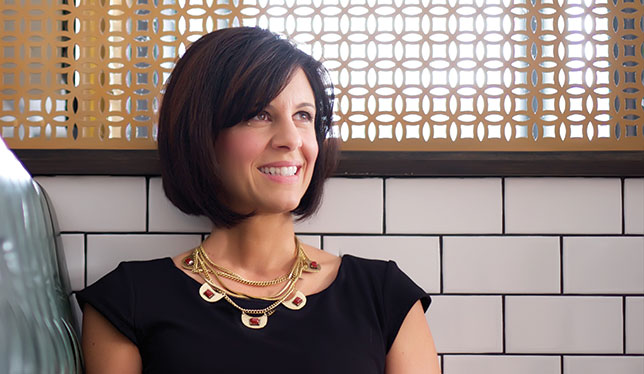
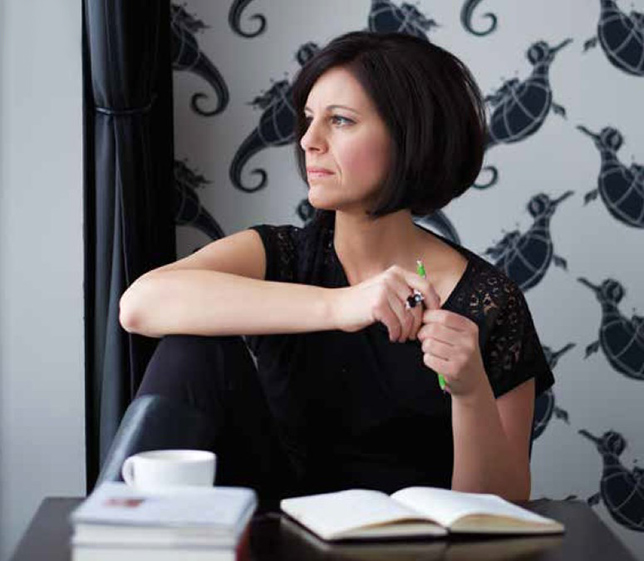
Whatever her interests, law professor Melanie Adrian pursues it all with a trail-blazing passion. Photo by Scott Adamson.
Whatever her interests, law professor Melanie Adrian pursues it all with a trail-blazing passion. Photos by Scott Adamson.
“Melanie is a really great example of what happens when you take student voices seriously,” says Samah Sabra, a coordinator in Carleton’s Educational Development Centre who is researching the pedagogical outcomes of Dr. Adrian’s third-year course.
“Relentlessly innovative,” adds her law department colleague Vincent Kazmierski. “She’s an incredibly passionate person and she brings that passion to her teaching.”
Dr. Adrian’s student-centered style earned her a Carleton University New Faculty Excellence in Teaching Award in 2014. At year end, she learned she’d won one of the five distinguished Teaching Achievement Awards that the university bestows annually.
For former student Carla Carbajal, who took Dr. Adrian’s first-year law course four years ago, the assignment to present a hip hop song allowed her to connect her past – she had emigrated as a teenager from a dangerous neighbourhood in El Salvador – to her studies in Canada where she was still struggling to find her place. For a course project, she returned to El Salvador to do research in a school for children with intellectual disabilities and interview government officials about laws regarding child protection. Dr. Adrian even helped her organize an in-class bake sale to raise money for the school. Ms. Carbajal went far beyond what was needed for a first-year course, but her classroom experience had lit a fire: “I told other students, ‘Make sure you take a class with Dr. Melanie Adrian, because she will change your life and she will show you what university should be like.’”
A deliberate and creative approach to constructing meaningful learning – her own and others’ – has been standard practice for Dr. Adrian throughout her academic career. She also has a gift for persuading others to make allowances for the new trail she may need to blaze to get there – a friend says she could sell a used tea bag if required. Her warm, energetic personality, genuine interest in people and knack for making contacts haven’t hurt either.
Dr. Adrian embarked on her first ethnographic study during an under-graduate co-op term with an Asian human rights organization in 1995, when she interviewed people on the margins of Hong Kong society. She had no idea that that was what she was doing – “I just really wanted to go and talk to people and get to know their stories and write them down” – but she nevertheless convinced a professor at the University of Waterloo to accept the work for credit, and presented it to interested faculty and students when she got back.
“I charted out a very different course,” she says about her first degree in religious studies with a minor in peace and conflict. It was where she began developing an academic interest in Islam (she has no religious affiliation herself). The degree program was something she used to “get to know areas of the world I didn’t know. … I got an idea, then I convinced the administration to let me do it as a co-op term.”
Her persuasiveness and focus on exactly what she wanted to learn carried into her doctoral work at Harvard University in religious studies and human rights. Unable to find any one department that was able to supervise the work she wanted to do, she crafted her own interdisciplinary doctorate straddling religion and anthropology.
“It takes a lot of courage to do that. … She was the only student I have worked with who put together her own PhD program,” says Kimberly Theidon, a medical anthropologist who supervised Dr. Adrian at Harvard (she’s currently a fellow at the Woodrow Wilson International Center in Washington, D.C. and associate research professor at Tufts University). She credits her student for being “willing to follow the questions to where they take her.”
The doctoral candidate began by researching Muslims in Peru but switched focus to the divisive controversy unfolding in France over the display of religious symbols in schools, including a ban against Muslim girls wearing head scarves. She wanted to find out what the state’s position would mean for young Muslim women. “I just didn’t understand why they would go that far,” she says about the recommendations from France’s Stasi Commission in late 2003.
A commission member helped her arrange a one-year English teaching position at a high school in a Paris suburb and get clearance for the deep access she felt she needed. She soon found such banlieues had residents who were second- and third-generation French citizens yet were so isolated that they struggled to be accepted as French by those outside. Even the school she worked and lived in was divided: it had an academic program that educated mostly white middle- and upper-class students bussed in from outside the neighbourhood and a more volatile trades program filled with students of immigrant backgrounds from the immediate neighbourhood who lived with poverty, crime and violence.
Then the riots of October and November 2005 broke out. Some 250 cars were burned in the school’s vicinity. By day, Dr. Adrian would teach and learn from her students. But on several nights, some returned to help firebomb the school and staff residences, where she lived, targeted as a state symbol. Their English teacher helped put the fires out, but she spent many a night lying awake wondering if she’d be burned alive in her bed. She realized that she was caught up in a conflict too big to be personal.
She turned it into a teachable moment. In her trades classes she would hold up a newspaper clipping about the events from the night before and simply ask, “Why?” With her more privileged students, she would write provocative statements on the blackboard, such as “France is racist,” and let an animated discussion ensue, something she says could only happen because an atmosphere of mutual respect and trust had already been established. Students were practising their English, certainly, but their teacher also gained a window into their worlds and opinions. She used hip hop music for the first time as another conversational springboard.
What she learned forms part of her first book, Risking Religious Freedom: France, Muslims and the Right to Act on Faith, expected to be published in the fall of 2015. Among the insights she came away with was “a very deep appreciation of how local and domestic concerns can shape and create policy that either is or isn’t in conformity with human rights norms.”
While she understands France’s reasons for banning the hijab in schools, she doesn’t believe it’s a good policy and worries this and other similar policies are putting liberalism at risk: “If the state can tell you what you can put on your head, what else can it tell you?”
Negotiating space for cultural difference was something Dr. Adrian learned at a young age. She grew up with three sisters in a German-Canadian household in Waterloo, Ontario, that more often than not put up visiting students from all over the world. Over a 15-year period the family hosted more than 30 students who stayed from six months to a year.
As well, her parents had “a really strong focus on justice. It was part of my daily life from the time I can remember.” Her late father, Werner, was a respected optometry professor and inventor at the University of Waterloo. Her mother, Elisabeth, was a role model for openness and community involvement, someone who rolled up her sleeves and helped when she saw someone or something that needed attention.
“We talked about the world, but the world was at our table,” says Dr. Adrian. Such an experience, she says, “creates a very specific type of environment that is outward-looking, receptive to culture and ideas, that forces you to negotiate your identity all the time. … I have sisters and brothers around the world because of that.” As a high-school student, she travelled on international exchanges, becoming fluent in Spanish and French.
Her pedagogical ideas really started to germinate when she became a Harvard lecturer after finishing her PhD in 2007. During those “three wonderful years,” she experimented with variations on flipped classrooms and field trips to religious sites, even art galleries, to help students connect what was being discussed in the classroom to how it played out in the world beyond Harvard.
Her legal orientation had come from her master’s program under the direction of the late Kevin Boyle, a human rights lawyer and activist at the University of Essex. Once she arrived on campus in 1998, she learned that the star attraction that had drawn her to Essex in the first place was on sabbatical. She negotiated her way into doing research for Dr. Boyle during his break and he helped pave her way by bringing her along on his speaking engagements – one to the British parliament on interreligious dialogue – and promoted her CV to academics in the field once she announced her intention to pursue a doctorate. She believes that supporting students in that way is “the kind of thing we in academia have to do.”
The concept of risk took on a very personal dimension in early 2011. Just months into her first tenure-track position at Carleton and weeks after returning from another surfing vacation, she was diagnosed with invasive breast cancer. Amid the shock and horror of the news was also disbelief that the only treatment she was offered was a classic mastectomy with reconstruction to follow later. At just 37 and with all the attention breast cancer had been receiving, she could not accept that that was her only option.
“It just seemed so barbaric to me that we have been running, walking, jumping, flying, biking for the cure … and the only thing that these surgeons can tell me is that ‘You’ve gotta cut it off?’ It just didn’t compute to me,” she says.
Within a couple of weeks she had worked her international contacts and learned that she was a good candidate for another procedure. A skin- sparing mastectomy removes all but the breast’s skin envelope, and the breast is rebuilt right then. The challenge was finding someone who could do it in Canada – fast. Meanwhile, she was finishing the winter term at Carleton, teaching an online course through Harvard, and consulting for UNICEF on an evaluation of its development programs in the context of international human rights law.
feature_melanieadrian_644_2
The call that she had an appointment with Nicole Hodgson, a surgeon performing the skin-sparing procedure at Hamilton’s Juravinski Cancer Centre, came while she was in Senegal in early May for UNICEF. She had less than two days to make it to the Hamilton clinic.
“Our administrative assistant had to sell her first child to Air France to get me a seat from Dhakar to Toronto,” she jokes. Before the end of the month she’d had the operation, revealing that her cancer was advanced. That required a full suite of follow-up treatments – aggressive chemo-therapy and radiation, with their own side effects and life-altering considerations, things that Dr. Adrian believes can be too easily glossed over by doctors intent on saving patients’ lives.
An anthropologist, she talked to other cancer patients and found the systemic pitfalls she’d dealt with were common, and that “really, really bothered me.” As a human rights champion, she decided to do something about it.
She sought out senior administrators from the Ottawa Hospital and started talking to them about why she’d had the experience she’d had and what could be done to give breast cancer patients equal and hassle-free access to all the information and treatments available. They were receptive, although the hospital says it was already moving along the same lines. “I see the change,” she says, crediting those in charge for hiring surgeons who could offer expanded treatment options. A hospital expansion will consolidate all its breast cancer specialists and services into one hub.
However, the true shift, she realized, had to happen among patients so that they could take an equal seat at the table of their own treatment. So, with lots of help from friends, former students, cancer survivors and specialists, she founded Be the Choice, a not-for-profit organization whose goal is to give breast cancer patients the knowledge and language they need to make more informed choices about their care. Its key project is the development of a multilingual, online decision tree that takes the user step by step through the questions they need to consider and ask, and options that can be available, depending on the patient’s type of cancer and stage of life.
“This is not about removing the doctor at all,” says Dr. Adrian, whose group has consulted heavily with expert physicians during the tool’s development. “This is about empowering, informing, so patients have a more interesting conversation with their doctor.”
Throwing herself into such an intensive project while still recovering from cancer treatment herself does not surprise those who know her. Her mother, also a breast cancer survivor, says her daughter is someone “who goes as far as she can get. She’s not afraid.”
“It’s a testament to her passion,” says Robin Beasley, a Carleton colleague who was diagnosed with breast cancer at age 40, shortly after Dr. Adrian, and who co-founded Be the Choice with her. “Her vision is making change for women in Ottawa and across the country. It’s about making things accessible.”
With Be the Choice’s decision-making tool nearly ready to launch (bethechoice.org), Dr. Adrian climbed back onto her beloved surfboard and the Pacific Ocean’s waves this winter while finishing her book. But before she left, she was making plans to take her students “to a whole new pedagogical zone” when she’s back in Ottawa this summer. In her summer course on social justice and human rights, she wants to incorporate student interviews with high-profile “justice makers” and members of the Ottawa community, to encourage students to think deeply about what it takes to be an ethical decision-maker.
She explains, “I don’t just teach for knowledge’s sake. I teach so I can hopefully spark a passion or an interest in the students. If the students leave with the idea that their critical thinking is necessary and useful and that they can contribute by engaging in that kind of thought, then I feel that I’ve done my job.”

Wednesday, April 9, 2014

So Much to Do, So Little Time

reposted from

So Much to Do, So Little Time
April 9, 2014
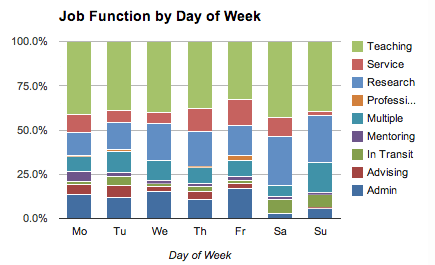
Professors work long days, on weekends, on and off campus, and largely alone. Responsible for a growing number of administrative tasks, they also do research more on their own time than during the traditional work week. The biggest chunk of their time is spent teaching.
Those are the preliminary findings of an ongoing study at Boise State University -- a public doctoral institution -- of faculty workload allocation, which stamps out old notions of professors engaged primarily in their own research and esoteric discussions with fellow scholars.
“The ivory tower is a beacon — not a One World Trade Center, but an ancient reflection of a bygone era — a quasar,” John Ziker, chair of the anthropology department at Boise State University, says in a new scholarly blog post in which he discusses his faculty workload findings. “In today’s competitive higher-education environment, traditional universities and their faculty must necessarily do more and more, and show accomplishments by the numbers, whether it be the number of graduates, the number of peer-reviewed articles published or the grant dollars won.”
Ziker’s Blue Review post continues: “It is harder to count — and to account for — service and administrative duties. These are things we just do because of the institutional context of Homo academicus, and it’s hard to quantify the impact of these activities or the time spent, but they are exceedingly important for intellectual progress of the larger Homo clans.”
But of course just how professors spend their time has major implications for faculty, students and their institutions, he says – especially as Boise State has recently adopted a policy that professors should spend 60 percent of their time teaching. Hence the need for the Time Allocation Workload Knowledge Study, or “TAWKS.”
Using a modified version of the anthropological technique “24-hour recall,” 30 tenure-track and tenured study participants were asked to report everything they did from 4 a.m. on the previous day to the day of the recall interview. Ziker says the technique is especially good at capturing rare and common activities than other methods. About half the participants provided a full week’s worth, or seven days, of data, and others provided one to six days’ worth of data. Responses for all 166 days were coded to determine exactly how the professors were spending their working hours. (Time spent on truly personal activities was not included in the study.)
The study is only in its early stages, and the findings from what Ziker calls Phase 1 are anything but conclusive. The sample size is small and participants were not chosen randomly (all 550 Boise State full-time faculty members were asked to participate but just 30 responded). But Ziker says the findings are “highly suggestive” because they are so consistent across participants. In an interview, Ziker said he didn't know how representative the findings were of institutions others than Boise State, but said that future phases of the study would involve outside professors.
On average, faculty participants reported working 61 hours per week – more than 50 percent over the traditional 40-hour work week. They worked 10 hours per day Monday to Friday and about that much on Saturday and Sunday combined. Perhaps surprisingly, full professors reported working slightly longer hours both during the week and on weekends than associate and assistant professors, as well as chairs.
Ziker says the most surprising finding so far is that faculty participants spent 17 percent of their work week in meetings – including those with students – and 13 percent of the day on email (both for research and with students).
So combined, he says, 30 percent of faculty time “was spent on activities that are not traditionally thought of as part of the life of an academic.”
About one-third of work-week days – 35 percent – was spent on teaching, including 12 percent for instruction and 11 percent on course administration, such as grading and updating course webpages.
Just 3 percent of the work-week day was spent on primary research and 2 percent was spent on manuscript writing.
On the weekend, faculty spent about 23 percent of their working time on class preparation, 13 percent on course administration, 10 percent of the time on email, and 9 percent at workshops and conferences. Professional conversations, manuscript writing and “housekeeping," such as updating files, rounded out of the rest of the time.
Combining work week and weekend, faculty subjects spent about 40 percent of their time on teaching-related tasks, or about 24.5 hours.
Ziker points out that 24.5 hours is almost exactly 60 percent of a 40-hour work week.
“So, what is happening?” he asks. “Are faculty shirking their teaching duties, or is workload policy geared for a time and place when success was defined largely by teaching?”
Probably not. Because research – “and the external funding and recognition it brings” – makes up just 17 percent of the work week and 27 percent of weekend work, he says, faculty members have an “entrepreneurial spirit, a willingness to exploit their free time for work.”
Matthew Genuchi, a professor of psychology at Boise State who is Ziker's co-investigator, said in an interview that "there appears to be something quite paradoxical occurring" with the findings on research, given that research and grants are "the most valued in the tenure and promotion process." He noted, however, that the study did not take into account summer work habits -- when faculty members may have more time to do research. Ziker said that is when he personally gets most of his research and writing done, as well as during other breaks throughout the year.
The study also gives insight into exactly where professors are carrying out their work. Some 59 percent of work – or 36 hours per week – takes place on campus, with 24 percent of work taking place at home and 17 percent of work taking place at other off-campus locations.
As to how academics are working, the study suggests they’re working mostly on their own – alone 57 percent of the time. Only 17 percent of participant time was spent doing activities with colleagues and 15 percent of our time was spent doing activities with students.
“Being a faculty member appears to be a lonely occupation,” Ziker says.
Genuchi said he was surprised by the "loneliness" finding. It demands further study, he said, but one possible implication could be that "faculty may feel generally isolated even though they work in a setting that is full of people, including colleagues and students."
Additionally, he said, it may be saying something about the overall trend in higher education toward inter- or transdisciplinarity. "While faculty may be shifting toward engaging in work with colleagues across disciplinary lines, they appear to be engaging in a majority of that work in isolation."
Ziker agreed, saying that the dynamic stands in particular contrast to graduate school or post-doctoral appointments, when "academics are used to having a lot of time in conversations and contact with colleagues."
When faculty members were working with other faculty members, the main activities were meetings, professional conversations, conferences and workshops and research dissemination.
Collaborative research and especially teaching “appears to take a back seat in faculty meetings,” Ziker says.
The American Association of University Professors doesn’t have good, recent data on faculty workload allocation with which to compare the TAWKS data. The best available data, from 2003 (taken from the National Study of Postsecondary Faculty), show that full-time faculty members work 53.4 hours in a week. About 62 percent of that was teaching, including course preparation and advising, with 18 percent devoted to research and 20 percent to percent administrative and other tasks.
For full-time faculty members at four-year colleges and universities, such as Boise State, those figures show that faculty worked 54.4 hours per week, with about 58 percent of time spent on teaching, 22 percent of time on research and 20 percent on administrative and other tasks.
John Curtis, director of research and public policy for the AAUP, said there currently is “a lot of pressure on faculty members to increase the time they spend on all three aspects of their work.”
Legislators and the general public emphasize teaching as a priority, he said, “because that’s what they think of as the primary, if not exclusive, work of faculty members, and it’s very visible.” Tuition also brings in additional revenue in for colleges and universities in some situations,” he said, “which administrators like.”
At the same time, institutions value research because it brings in external funding, Curtis said – a point Ziker makes. It’s also the “primary source of visibility and rewards,” such as publication, tenure and promotions, for faculty members.
Many tasks fall under the “broad heading” of service, Curtis said, and there’s also administrative reporting to the institution: student learning assessment exercises and reports; committees for hiring, promotion, curriculum, and budget planning; departmental, school or college, and university administration; student activities; and service to disciplinary associations and community service organizations.
So the best answer to the question, “How do faculty members get anything done?” is “most often that they work longer hours” he said.
Ziker and Genuchi are currently working on Phase 2 of the study, in which participants will use a smartphone app they've have developed. The phase will be based on a method called “experience sampling,” in which participants respond or “check in” to text messages they receive at random times, to report what they are doing. The phase also includes a daily self-report about satisfaction with daily productivity.
“Linking time allocation to productivity will allow us to investigate a number of ideas about what makes for successful and happy faculty,” Ziker says.
Ultimately, the TAWKS team wants to develop a tool to help faculty reflect regularly on their productivity levels and work patterns.
“Promoting accountability to self demonstrates academic freedoms and provides a way to augment the reporting approach to workload that is likely not going away,” Ziker says. “If we can make the road of Homo academicus less lonely in the process, it won’t seem long at all.”

Please review our commenting policy here.


Read more: http://www.insidehighered.com/news/2014/04/09/research-shows-professors-work-long-hours-and-spend-much-day-meetings#ixzz2yOl3bt8k
Inside Higher Ed 

Wednesday, March 12, 2014

The Least Stressful Jobs Of 2013

reposted from


The Least Stressful Jobs Of 2013

University professors have a lot less stress than most of us. Update: Well maybe not, see ADDENDUM below. Unless they teach summer school, they are off between May and September and they enjoy long breaks during the school year, including a month over Christmas and New Year’s and another chunk of time in the spring. Even when school is in session they don’t spend too many hours in the classroom. For tenure-track professors, there is some pressure to publish books and articles, but deadlines are few. Working conditions tend to be cozy and civilized and there are minimal travel demands, except perhaps a non-mandatory conference or two. As for compensation, according to the Bureau of Labor Statistics, the median salary for professors is $62,000, not a huge amount of money but enough to live on, especially in a university town.
Another boon for professors: Universities are expected to add 305,700 adjunct and tenure-track professors by 2020, according to the BLS. All of those attributes land university professor in the number one slot on Careercast.com’s list of the least stressful jobs of 2013. The ranking comes from an annual best and worst jobs list that began in 1995 under the auspices of the Wall Street Journal. In 2009 the Journal dropped the ranking, which then moved over to CareerCast.com, a career and job listing website based in Carlsbad, Calif. Thebest and worst jobs listing, which ranks 200 jobs according to more than 100 criteria, comes out in April. This is the third year CareerCast has released a list of least and most stressful jobs, derived from its best and worst lists.
To gauge which jobs are the least stressful, CareerCast considered the 200 professions in its database and focused on 11 different job demands that it deemed likely to provoke stress, including travel, growth potential, competitiveness, physical demands, hazards, environmental conditions and risk to one’s own life or to others’.
According to Tony Lee, CareerCast’s publisher, the least stressful jobs have one thing in common: autonomy. “These jobs tend not to have someone standing over their shoulder putting pressure on them to get things done,” he says. University professors answer to themselves, he points out. “They are basically kings of their own fiefdoms.” The same is true for the other jobs on the least stressful list, including seamstress/tailor, which ranks second. “In these jobs, you’re doing something for which you are highly qualified and you’re the expert in how to get things done,” he adds. That’s the case for medical records and medical laboratory technicians, ranked numbers three and five on the list. Those jobs must be done with precision. The people who do them tend to work on their own, without much supervision. The same goes for jewelers, number four on the list, audiologists, dieticians and hair stylists.
The other thing most of the least stressful jobs have in common: At the end of the day, people in these professions can leave their work behind, and their hours tend to be the traditional nine to five.
None of the salaries for these professions top $100,000 and some are quite low, like seamstress/tailor with a median salary of just $26,000 and hair stylist, at $22,500, according to BLS numbers. But compensation was just one of the things CareerCast measured.
Though hair stylists make the lowest salary on the list, they are among the happiest, says Lee. Their colleagues and clients tend to become friends and they get lots of positive feedback and thanks for their work. “With a lot of these jobs, you’re getting warm fuzzies as you work,” he notes.
***ADDENDUM***
Since writing the above piece I have received more than 150 comments, many of them outraged, from professors who say their jobs are terribly stressful. While I characterize their lives as full of unrestricted time, few deadlines and frequent, extended breaks, the commenters insist that most professors work upwards of 60 hours a week preparing lectures, correcting papers and doing research for required publications in journals and books. Most everyone says they never take the summer off, barely get a single day’s break for Christmas or New Year’s and work almost every night into the wee hours.
Many of the comments are detailed, with time breakdowns laying out exactly how many hours the writers spend doing their jobs. One commenter, Jonathan Reynolds, sent me an itemized list of tasks he’d performed since Dec. 19 which included writing a 12,600-word book chapter and a 1,000-word book review, peer reviewing a manuscript for an editor, reviewing manuscripts for a professional journal and one for Oxford University Press. He also worked on an annotated bibliography and helped a struggling student. I agree that doesn’t sound like a relaxing schedule.
A commenter named Gwen Schug sent along a link to a well-written pieceresponding to the study I cited, detailing the hours it takes to do every aspect of a professor’s job, including the three hours preparation required per lecture, the fact that most professors have up to 55 advisees, each of whom requires at least an hour per semester, and grading, which can take a half hour per assignment. The piece also says professors are expected to attend 2-4 conferences a year, and points out that universities rarely pay the full expense.
I appreciate all of the comments and encourage you to read them. My intention here was to relay an intriguing list put together by a career and job listing site, CareerCast, that surveyed data on 200 jobs and drew up a list of professions it deemed least stressful, according to metrics I describe above, which are weighted toward categories like physical demands, environmental conditions and risking one’s life. CareerCast didn’t measure things like hours worked and the stresses that come from trying to get papers published in a competitive environment or writing grants to fund research.
I think there is value in CareerCast’s list, but I also welcome the observation that my characterization of a professor’s duties failed to include the stress brought on by long hours and the pressure to publish scholarly work. Though I happen to know a tenured professor who enjoys several breaks during the year and takes a several-week vacation over the summer, I didn’t set out to report exhaustively on the hours professors work. Unquestionably, the number varies greatly and is often high.
All of that said, to me the most striking thing about the comments I received is the fact that so many professors write that while they find their jobs stressful, they are deeply satisfied and happy in their work. This comment from David Perry is typical: “I love my job. It’s definitely deeply rewarding. But the stresses are intense and the workload never ending.”