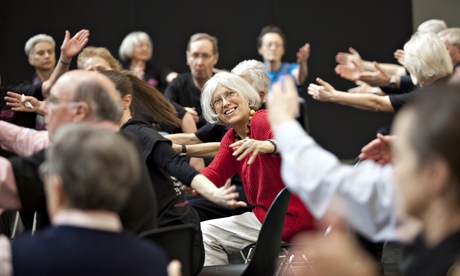
English National Ballet is among the affiliates of the Dance for Parkinson’s programme that originated in Brooklyn in 2001. Photograph: Belinda Lawley
Dance is having a moment that’s not about knuckle-headed judging on Strictly, star ballerinas or a cool new choreographer, but about the fascinatingly therapeutic uses to which the art form is increasingly being put. Dancers are being used in the training of doctors, helping themdevelop skills of empathy and communication, but dance is also being utilised to engage more directly with the patients themselves.
A new film, Capturing Grace, spotlights the work being done at the Mark Morris Dance Center (MMDG) in Brooklyn. Dance for Parkinson’s Diseaseis a project that started in 2001 when Olie Westheimer, director of the Brooklyn Parkinson Group (BPG), approached Morris about the possibility of the centre leading a programme of serious, rigorous, dance classes for members of her group.
Westheimer knew how valuable the dancers’ expertise in balance, rhythm, control and sequencing might be to those with Parkinson’s disease. Learning to dance might allow them to push against the physical and creative limitations imposed by the disease. Two members of the Mark Morris Dance Group, with a composer and pianist, began giving free monthly classes for the BPG. The sessions have since developed into an extensive programme.
The motor problems that affect people with Parkinson’s disease principally affect voluntary rather than instinctive movements. No one quite knows the science of it, but it seems that something about dancing to music – about imitating a teacher, about developing a muscle memory of dance sequences – seems to temporarily alleviate that problem.
It is not a cure, but while it’s happening it can feel like a liberation. Certainly, as Dave Iverson’s film traces Parkinson’s Dance participants, following them as they train towards a public performance, it shows them gaining confidence and a moving sense of physical freedom.
The success of this programme in transforming lives and expectations has been publicised by the MMDG wherever they appear, and there is now a network of affiliate programmes across the US and in nine countries around the world. In Britain it’s been picked up by English National Ballet, who’ve been running classes at their Kensington base since 2012 as well as operating the scheme at centres in Oxford, Liverpool and elsewhere.
Dancers know about the power of their discipline to combine mind, body and emotion – to create a concentrated, of-the-moment experience – and that’s why dance has also become so useful in the treatment of patients with Alzheimer’s and other forms of dementia. Initiatives like the Centre of Excellence in Movement Dance and Dementia or Circle Dance in Dementia or the American Dance Therapy Association work on the principle that, as individuals lose command of the world they have always known, dance sessions can build a temporary alternative of sound, movement and rhythm. Dance can also introduce a regular experience of physical intimacy and touch, often the things of which patients feel most bereft.
In societies far older than ours, dance was integrated into the daily fabric of people’s lives: in religious dances, war dances, fertility dances, child-birthing dancers, even dances that incorporated the rituals of trading. It is curious that, as we become increasingly hi-tech and ever more in thrall to Big Pharma in our handling of illness, we’re also learning to access and exploit the traditional ways.
Music and rhythm are fundamental and essential components of human civilization. From traditional Papa New Guinean log-drums (some of which live on Stanford’s campus), to Indian tabla, to modern computer-generated sound design: musical rhythm reverberates across an incredibly diverse range of cultures and times. Even non-musicians experience music in complex ways. For instance, when we dance we anticipate beat placement to coordinate our hands, feet, arms, and legs, while also twirling our dance partners in sync with the music (or so we hope).
Our need for music has also materialized in the clinical world.It has been shown that patients with Parkinson’s disease, who often exhibit difficulty initiating motor movements, can move more fluidly when listening to music. These patients who struggled simply to walk are able to move freely with remarkable rhythm when listening to their favorite songs. While anecdotal, these impressive results suggest the dire need to better understand the nature of music’s influence over the brain, and possibly tailor music as a novel neurological therapy (ref 1).
Although musical cognition may seem trivial, our brains must process an enormous amount of auditory and motor information to engage with music and internalize its meter. How is it that we are able to ‘count’ the meter of a song and prepare our movements accordingly? What is it about steady meter that facilitates movement in patients with motor disabilities? Unfortunately, despite our common interactions with music, extremely little is known regarding how our brains process it.
Brain waves: what are they, and what do they do?
One reason for our lack of knowledge of musical processing stems from the technological limitations of recording from human brains. Two non-invasive techniques that can measure the activity of the brain are theelectroencephalogram (EEG) and magnetoencephalogram (MEG), which record electrical and magnetic signatures of neural activity, respectively. These techniques are useful when using rapidly changing stimuli such as music because they can record instantaneous electromagnetic changes in the brain. On the other hand, they are limited in their spatial resolution. A helpful analogy is to imagine an EEG or MEG electrode as a microphone hanging over a large stadium – the microphone will pick up a large roar after a touchdown, but cannot discern individual conversations.
Despite their limitations, these techniques enable us to record oscillating “waves” of activity that occur normally in our brains and which may give us insights into the brain activity underlying musical processing. Essentially, these brain waves are electromagnetic patterns that arise from the activity of our neurons and the communication between different regions in our brains. Various waves have characteristic frequencies and are associated with different processing tasks. In fact, these different wave frequencies are so common that they have been given identifying names using the greek alphabet (gamma, beta, delta, etc).
Two particular types of brain waves – beta (β: 15-20 Hz) and gamma (γ: 30-100 Hz) – may have implications for musical cognition. Past studies have found β waves are generally associated with active planning, thinking, and more specifically, motor planning, movement, and control. γ waves, on the other hand, are associated with deep concentration and have been observed to fluctuate with external visual and auditory sensory input. Given that these waves are correlated with muscular coordination and sensory stimuli, respectively, new theories have proposed that they are also involved in music and beat processing (ref 2,ref 3).
β and γ waves respond differently to missing beats.
β waves oscillate along with a series of rhythmic auditory stimuli (top panel, upper half), but when one stimulus is left out (time 0), they temporarily stop oscillating (top panel, lower half).
γ waves oscillate in a different pattern along with a series of rhythmic auditory stimuli (bottom panel, top half), but when one stimulus is left out (time 0), they generally maintain their oscillation pattern (bottom panel, lower half).
Might Beta and Gamma waves facilitate steady musical beat perception?
Takako Fujioka, a new professor at Stanford University, and her colleagues have discovered that β and γ waves are indeed important for beat perception. The researchers had non-musicians passively listen to sequences of steady beats while they recorded from the subjects’ auditory cortices (the region of the brain responsible for sound perception)using MEG. They discovered that β and γ waves precisely followed the beats with periods of low and high amplitudes. When they looked more closely, the researchers found notable differences in how the two types of brainwaves followed the rhythm of the beats. When the researchers occasionally omitted a beat during the sequence, they discovered that β remained at an elevated level but γ continued on its normal path, as if the beat had actually been heard. In other words, although both wave trajectories followed the rhythm of the beats, only γ was able to maintain the rhythm when a beat was skipped (ref 4, see figure). This suggests that as we listen to music, specific brain waves are associated with different aspects of the music – part of our brain seems to be listening carefully to the actual beats we hear, while other aspects of brain activity appear to be predicting the beats we expect to hear.
Moving again to the beat
These new findings on brain waves may give some insight behind symptomatic motor stiffness observed in many patients with Parkinson’s disease, and the fact that music sometimes allows these patients to move normally. Parkinson’s patients often have highly elevated β waves, which are associated with resistance to movement initiation. As mentioned, Dr. Fujioka and her team discovered that β waves decrease in amplitude immediately following each beat in a sequence. Perhaps music facilitates movement in these patients by affecting the underlying neurological processes behind their β waves in ways that decrease β wave amplitude and help initiate movement. Although there is still much more to investigate on this topic, these new findings are promising and have opened a door for future research in this field.
REFERENCES:
1: de Dreu, M. J., van der Wilk, A. S. D., Poppe, E., Kwakkel, G., and van Wegen, E. E. H. (2012). Rehabilitation, exercise therapy and music in patients with Parkinson’s disease: a meta-analysis of the effects of music-based movement therapy on walking ability, balance and quality of life. Parkinsonism & Related Disorders, Volume 18 (Supplement 1): S114-S119. doi: 10.1016/S1353-8020(11)70036-0.
2: Joundi, R.A., Jenkinson, N., Brittain, J.-S., Aziz, T. Z. and Brown, P. (2012). Driving Oscillatory Activity in the Human Cortex Enhances Motor Performance. Current Biology, Volume 22 (Issue 5): 403-407. doi: 10.1016/j.cub.2012.01.024.
3: Noda, T., Kanzaki, R., and Takahashi, H. (2013). Amplitude and phase-locking adaptation of neural oscillation in the rat auditory cortex in response to tone sequence. Neuroscience Research, available online 15 November 2013. doi: 10.1016/j.neures.2013.11.002.
4: Fujioka, T., Trainor, L. J., Large, E. W. and Ross, B. (2009), Beta and Gamma Rhythms in Human Auditory Cortex during Musical Beat Processing. Annals of the New York Academy of Sciences, 1169: 89–92. doi: 10.1111/j.1749-6632.2009.04779.x

 Email
Email