Showing posts with label attention. Show all posts

Friday, October 2, 2020

This Is Why You Get Zoom Fatigue

 reposted from


This Is Why You Get Zoom Fatigue

  • Published23 Sep 2020
  •  
  • Author Alexis Wnuk
  •  
  • Source BrainFacts/SfN
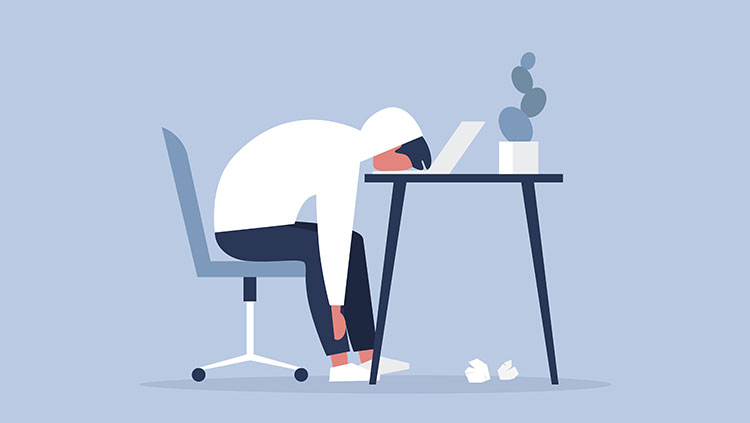
Person asleep on desk
Nadia Snopek/Shutterstock.com

I groaned at the incoming text message: “Join our Cloud HD video meeting.” It was a friend inviting me to a virtual movie night. More than six months into the coronavirus pandemic, the novelty of virtual happy hours and virtual movie nights had long worn off. As much as I missed my friends, the thought of watching a movie online together — of unmuting myself to interject what I hoped was witty commentary and then promptly re-muting myself to avoid the audio feedback — was exhausting.

I’m not alone.

“Even when I’m not in professional meetings but just hanging out with my friends and family, I kind of feel like there’s this one-hour mark that I hit where I’m like, ‘I can’t do this anymore,’” says psychologist Adrienne Wood.

It turns out that video chats tax our brain’s attention systems without delivering the same social rewards as face-to-face interactions — leaving us exhausted and dissatisfied.

Focus Fatigue

Group video chats — especially Zoom’s Brady Bunch-like gallery view — present an unusual challenge for our brain’s visual attention system, says Sabine Kastner, a neuroscientist at Princeton University. During in-person conversations, our attention focuses on the person we’re speaking with; everyone else in the room fades into the background. “Whereas in a Zoom meeting, it seems that everybody is always there,” she says. “They are kind of a huge distraction that is not so easy to filter out.”

That’s because our brains process a lot more visual information than we realize. Kastner and colleagues demonstrated this in a series of experiments where they showed people photographs of natural scenes. The images appeared for only 100 milliseconds — less than an eyeblink — yet participants could easily say whether there was a person or car in the image. It shows we can process multiple things at the same time, rather than having to go through each item in a scene one by one, Kastner says.

And, while our visual attention system is tuned to filter out clutter in the environment, people are among the most attention-grabbing stimuli. “We are now basically confronted constantly with this sea of salient stimuli,” she says. We’re “completely overloaded, and that filter function is just not very effective.”

Video chats are a poor substitute for real, face-to-face interaction. A two-dimensional video of a person is nowhere near as attention-grabbing as a real person sitting next to you, Wood says. “I think that’s a huge reason that we find our attention span kind of dwindling when we’re talking to someone on video chat,” she says. “You’re not getting that boost in physiological arousal that keeps you alert.”

That means our brains work harder to maintain concentration throughout the interaction, leading to fatigue. In a 2008 study, doctors who watched lectures via live video feed said they felt more stressed and distracted and had a harder time following the speaker than doctors who attended the lectures in person.

Out of Sync

Our brains are attuned to conversations and social interactions in the real world. Even with a fast internet connection and a crisp display, video chats often have noticeable lags or disconnects between audio and video. This “reduces the fluency of the interaction,” making it harder to process, Wood says.

In a 2011 study, people reported feeling more frustrated during video chats when there was just a one-second delay. And, delays can color our perception — a 2014 study found people perceived the person on the other end of a conference call as less attentive and friendly when there was a 1.2 second delay.

“All of these things — the timing and the rhythm and the synchrony of conversation — are so fine-tuned that if you throw off any of these pieces, it’s just going to feel exhausting,” Wood says.

Signal Interference

Lags and low-resolution also make it harder to pick up nonverbal conversation cues like body language and facial expressions. “A lot of … nonverbal communication is very subtle and quick,” Wood says. For instance, “a quick raise of an eyebrow is all that it takes to communicate confusion.”

While we’re not always aware of these signals, our brains integrate them with what is being said to get a complete read of the conversation.

In her research at the University of Virginia, Wood has found we unconsciously mimic others’ facial expressions during social interactions, which helps us understand what another person is thinking and feeling.

Wood suspects we’re less likely to unconsciously mimic others during video chats —  either because it’s too low-resolution to discern others’ expressions or because their emotions are less relevant to us. “If a person looks surprised when they are on video chat 100 miles away, their surprise is not as immediately relevant to me because they might be reacting to something that just happened in their living room,” she says. “Whereas if we are in the same place, every emotion you experience is more relevant to me because it might be signaling something about our shared environment.”

What’s more, the most important body language of all is completely impossible on video chat: eye contact. If you’re in a room with other people, you can tell from their eye movements where their attention is directed. “In a Zoom meeting, I don’t know where they’re looking or what they’re doing at all,” Kastner says. 

Normally seamless interactions become stilted on video chat, social signals more difficult to detect, and our visual attention operates at max capacity. For all the cognitive resources we expend, we don’t get the same payoff we normally get from social interactions, Kastner says. “It just leaves me … in this empty space.”

She’s found it helpful to schedule breaks with physical activity and to limit the number of Zoom meetings she has each day. Sometimes, a simple phone call is better. The video doesn’t help the conversation as much as we think it does, she says. “If anything, it’s a huge distraction.”

Wood recommends hiding the self-video display, which can also be a big distraction. For her classes, she tries to mix things up so it’s not a sustained group discussion for a long time. We shouldn’t “expect people’s attention spans to be as long as they would be otherwise,” she says.

CONTENT PROVIDED BY

BrainFacts/SfN

Tuesday, October 15, 2013

Tip-of-the-tongue moments may be benign

reposted from here

[ Back to EurekAlert! ]Public release date: 16-Oct-2013
Print | E-mail Share Share
 Close Window ] 

Contact: Anna Mikulak
amikulak@psychologicalscience.org
202-293-9300
Association for Psychological Science 

Tip-of-the-tongue moments may be benign

Despite the common fear that those annoying tip-of-the-tongue moments are signals of age-related memory decline, the two phenomena appear to be independent, according to findings published in Psychological Science, a journal of the Association for Psychological Science.
Anecdotal evidence has suggested that tip-of-the-tongue experiences occur more frequently as people get older, but the relationship between these cognitive stumbles and actual memory problems remained unclear, according to psychological scientist and lead author Timothy Salthouse of the University of Virginia:
"We wondered whether these self-reports are valid and, if they are, do they truly indicate age-related failures of the type of memory used in the diagnosis of dementia?"
To find out, Salthouse and Arielle Mandell — an undergraduate researcher who was working on her senior thesis — were able to elicit tip-of-the-tongue moments in the laboratory by asking over 700 participants ranging in age from 18 to 99 to give the names of famous places, common nouns, or famous people based on brief descriptions or pictures.
Throughout the study, participants indicated which answers they knew, which they didn't, and which made them have a tip-of-the-tongue experience.
Several descriptions were particularly likely to induce a tip-of-the-tongue moment, such as: "What is the name of the building where one can view images of celestial bodies on the inner surface of a dome?" and "What is the name of the large waterfall in Zambia that is one of the Seven Wonders of the World?" Of the pictures of the politicians and celebrities, Joe Lieberman and Ben Stiller were most likely to induce a tip-of-the-tongue moment.
Overall, older participants experienced more of these frustrating moments than did their younger counterparts, confirming previous self-report data. But, after the researchers accounted for various factors including participants' general knowledge, they found no association between frequency of tip-of-the-tongue moments and participants' performance on the types of memory tests often used in the detection of dementia.
"Even though increased age is associated with lower levels of episodic memory and with more frequent tip-of-the-tongue experiences…the two phenomena seem to be largely independent of one another," write Salthouse and Mandell, indicating that these frustrating occurrences by themselves should not be considered a sign of impending dementia.
###
For more information about this study, please contact: Timothy A. Salthouse at salthouse@virginia.edu.
This research was supported by the National Institute on Aging and a Harrison Undergraduate Research Award from the University of Virginia.
The APS journal Psychological Science is the highest ranked empirical journal in psychology. For a copy of the article "Do Age-Related Increases in Tip-of-the-Tongue Experiences Signify Episodic Memory Impairments?" and access to otherPsychological Science research findings, please contact Anna Mikulak at 202-293-9300 oramikulak@psychologicalscience.org.


[ Back to EurekAlert! ]Print | E-mail Share Share Close Window ] 


AAAS and EurekAlert! are not responsible for the accuracy of news releases posted to EurekAlert! by contributing institutions or for the use of any information through the EurekAlert! system.


Saturday, October 12, 2013

The perils of texting while driving

http://www.eurekalert.org/pub_releases/2013-10/ip-tpo101113.php

[ Back to EurekAlert! ]Public release date: 11-Oct-2013
Print | E-mail Share Share
 Close Window ] 

Contact: Albert Ang
press@inderscience.com
Inderscience Publishers 

The perils of texting while driving

US research reveals that 4 out of 5 college student drivers have used their cell phones to send or receive text messages while driving despite the majority recognizing that the activity represents a risk. Garold Lantz and Sandra Loeb of the McGowan School of Business, at King's College, in Wilkes Barre, Pennsylvania, found that male drivers are more likely to engage in texting while driving but consider themselves more proficient drivers than others and so less likely to endanger themselves or others while doing so.
Analysis indicates 'texting impulsiveness' is positively associated with people who text frequently and those who text while driving, the team reports in the International Journal of Sustainable Strategic Management this month.
Earlier studies have suggested that texting while driving is on a par with driving while intoxicated with alcohol as a significant risk factor for highway accidents. Indeed, some research suggested that texting slows driver reaction times more than being drunk. Other studies reinforce the myth of multitasking and show that very few (2.5%) people can competently undertake two or more tasks at once. Moreover, our brains allow us to focus completely only on a single task at any given time, so those people demonstrated as multitaskers are simply better at switching seamlessly between two activities. Texting while driving is already banned in some countries, including the UK for this reason.
"There seems to be a mentality that use of electronic devices is dangerous for everyone but 'me'," the team says. While the US government has introduced a public awareness campaign based around the "distraction.gov" web site, the means to correct for such a risky practice as texting while driving is in dispute. The team's study provides useful empirical evidence regarding attitudes to this issue.
"If further research conclusively demonstrates that texting while driving is as dangerous as driving drunk this study suggests that a promotional campaign should be undertaken to assure that this point is clearly understood," the team suggests. Lantz points out that, "Our study, particularly our measurement of impulsiveness, is exploratory. We have been working to develop that measurement and it is still a work in progress," he says.
###
"An exploratory study of psychological tendencies related to texting while driving" in Int. J. Sustainable Strategic Management, 2013, 4, 39-49


[ Back to EurekAlert! ]Print | E-mail Share Share Close Window ] 


AAAS and EurekAlert! are not responsible for the accuracy of news releases posted to EurekAlert! by contributing institutions or for the use of any information through the EurekAlert! system.


Friday, April 26, 2013

cool attentional paper where you can surf the data and explore the published data

This is a repost of an interesting blog in BrainFacts

http://blog.brainfacts.org/2013/04/semantic-categories-and-the-brain/#.UXqj5is4Usp

http://www.gallantlab.org/
http://gallantlab.org/brainviewer/cukuretal2013/


Semantics, categories and the brain.


How the brain stores and manipulates categories of objects is a quite interesting scientific question – but a difficult one. Every noun in a language represents some sort of category. Oak trees, for instance, is a category that regroups every individual oak tree. Then, there are other words to regroup those specific categories within more general ones – trees is the category that regroups all of the trees, including oak trees. An even wider one is biological organisms, which includes bacteria, fungi, plants and animals. The semantic categories are related to each other, sometimes in a hierarchical fashion, up to the category everything, which includes all of them. Beyond this basic hierarchical organization, concepts are linked together by numerous rules. For instance objects of the category tree can growlook beautiful or age – but they cannot be sad, orhappy.
Understanding the brain mechanisms responsible for handling those complex relations would likely inform us on how language and human cognition work. One of the researchers who have been exploring those questions is Jack Gallant. Like most researchers people in the Gallant lab are publishing their results in scientific journals, but in this case they have also taken the time to create a website that anyone can use to see how the brains of their subjects reacted to different semantic categories. Their study is being published at Nature Neuroscience1, and we can already visualize brain activities using their Brain Viewer.

Me, playing with the Brain Viewer. Here I clicked to see the activity of the brain in response to the category “hook” while subjects were focusing on humans. The blue-colored brain means that neural activity was not related to the category. You can try it for yourself and see what happens when subjects are instructed to focus on cars, the brain becomes red, which means that the neural activity in these areas becomes much more related to the semantic category.
The theory that the authors wanted to test in this study is whether or not the brain’s representation of categories is influenced by what we are attending to. Imagine you are viewing a movie and I ask you to attend to humans. Now imagine I show you the same movie and ask you to attend to cars. This should modify a lot of things as to how you view the movie – you might attend to different parts of the screen, you might view different aspects of the movie, and what you think about during the movie might change.
The study finds that attending to cars expands the semantic representation of categories that are close to cars, while attending to humans expands the representation of categories closer to humans. Categories close to humans, for instance “Pedestrian”, “Child”, or “Animal” were encoded in more brain areas when subjects were instructed to pay attention to humans. Conversely, categories like “Motorcycle”, “Hook” or “Furniture” were encoded better by some brain areas when subjects were paying attention to cars.
This suggests that attention to a specific object in a category also has impacts on the way the brain encodes closely-related objects. The tools developed by the lab are pretty unique and I recommend to anyone interested in the subject to go try their Brain Viewer tool.


References
1. Çukur T., Nishimoto S., Huth A.G. Gallant J.L. (2013) Attention during natural vision warps semantic representation across the human brain. Nature Neuroscience doi:10.1038/nn.3381.