Showing posts with label mark morris dance group. Show all posts

Thursday, May 21, 2015

Parkinson’s Disease and Dance

reposted from


Parkinson’s Disease and Dance

Could dancing the tango improve cognitive function?
According to the non-profit organization Dance for PD® (Parkinson’s disease), the answer is yes.
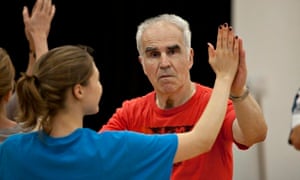
Because Parkinson’s is a brain disorder, some people thought it might be uniquely affected by something like dance. So they approached the Mark Morris Dance Group in Brooklyn, New York, about creating a program for people diagnosed with the disease.
We first wrote about this program in 2011, and decided it was time to look back and see if there has been any data on its effectiveness since then.
Dance for PD® has been holding classes since 2001 and has witnessed the profound positive impact it has had among participants. But most of thisHappy senior citizen couple dancing together and smilingevidence was anecdotal.
Scientific evidence of the program’s effectiveness was just beginning to be published.
In the nearly four years since I first started following Dance for PD®, the science has caught up. I heard about a 2015 study focusing on participants, but when I went to look it up, I was amazed at the number of studies published just in the first few months of 2015 that look at the topic.
Given this wealth of studies from research facilities around the world, I had a hard time highlighting just one. So instead, let’s look at some of the most recent findings on dance as an intervention for Parkinson’s:
  • 46 patients diagnosed with mild to moderate Parkinson’s participated in Japanese researchers Hiroko Hashimoto et al.’s study. They found that dance improved motor function, cognitive function, and mental symptoms. (Effects of dance on motor functions, cognitive functions, and mental symptoms of Parkinson’s disease: A quasi-randomized pilot trial. Complimentary Therapies in Medicine, Apr. 2015)
  • Researchers out of Canada and Sweden investigated the use of tango lessons to improve motor and non-motor functions of people with Parkinson’s Disease. They found that the Argentine tango can improve balance and functional mobility and are calling on larger studies to test benefits on cognition and fatigue. (Tango for treatment of motor and non-motor manifestations in Parkinson’s disease: A randomized control study. Complimentary Therapies in Medicine, Apr. 2015)
  • Irish investigators led by Dr. Amanda Clifford took ten participants and had them attend weekly Irish dancing lessons, along with a parallel home practice, over an 8-week period. This preliminary study found that Irish set dancing is feasible for people with Parkinson’s and could increase their quality of life (Is Irish set dancing feasible for people with Parkinson’s disease in Ireland? Complimentary Therapies in Clinical Practice, Feb. 2015)
  • A May 2015 [epub Feb. 2015] literature review in Maturitusconcluded that studies support the idea that dance can cause “substantial and wide-ranging benefits” in people who suffer from Parkinson’s, in addition to the older population in general.
One of the things that fascinated me about these studies was the sheer number of countries that are currently researching the neurological possibilities of dance for people with Parkinson’s.
This is a treatment strategy that could be used anywhere in the world.
And then, let the neuroplasticity begin.
In our Brain-Smart webinar series, we’ve been talking about practical and innovative strategies for working with the power of neuroplasticity to strengthen and heal the brain. The webinars are free to watch at the time of broadcast – you just need to sign up.
What are your reactions to using dance as a therapeutic intervention? Are there other innovative strategies you’ve used effectively with patients? Please leave a comment below.

Wednesday, May 6, 2015

Dancing proves a good move for people with Parkinson’s disease

reposted from


see also some of our past live stream discussion at NBS, NY and Houston.

I really like the person's description below:  "Joyce Plaice has been attending lessons in Plymouth for the past two years: “Dancing is the opposite of life with Parkinson’s, which I find is a slow, depressing slog – like walking through treacle. The tight muscles remind me of new knicker elastic with little give. But when I hear the music, the muscle tension eases and my mood lifts. I am doing what normal people do: socialising, making physical contact, using my brain to learn new steps. And my body gets a healthy boost with a much wider range of movements than it would get during the course of my day.”"

Another quote from the article which has impact "Only 1% of people with Parkinson’s in the UK live within reach of a dance practitioner specifically trained to work with them"


Dancing proves a good move for people with Parkinson’s disease

Staying active is crucial for those with this neurological condition and dancing has been shown to lessen tremors and improve flexibility, as well as lifting mood
Moving not shaking: dance has benefits for people with Parkinson's
 Moving not shaking: people with Parkinson’s benefit from dance sessions. Photograph: Rachel Cherry
Parkinson’s disease is a neurological condition that causes tremor, rigidity and slowness of movement, among other things. It affects around 127,000 people in the UK, and there is no cure. But while it is progressive and debilitating, getting the right medication and support after diagnosis can make all the difference to quality of life. One of the most difficult, yet crucial recommendations is to keep active – because mood, flexibility and balance can all be improved by activity.
Alison Underwood, who is in her 60s, was diagnosed with Parkinson’s 10 years ago and now runs a support group in the Llandudno area in Wales for others with the condition. “I set up a monthly dance group, that many of us find physically helpful and enjoyable,” she explains. “We do a lot of ‘free’, expressive dancing, and there is considerable emphasis on the fact that it doesn’t matter if you’re sitting or standing. The positive effect that dancing has on us is quite magical.”
Only 1% of people with Parkinson’s in the UK live within reach of a dance practitioner specifically trained to work with them. It was this statistic that inspired People Dancing, a community dance organisation, to join the US-basedDance for Parkinson’s group in putting together an online training programme to help dance teachers better meet their needs.
The online programme enables dance teachers to learn more about the condition, and helps them to adapt their lessons to make them more appropriate – and beneficial – for those with Parkinson’s. Anna Leatherdale, producer at People Dancing, is a dance practitioner and a member of the Dance for Parkinson’s Network UK. “The more that people with Parkinson’s can engage with dancing, the more benefits they’ll feel,” she explains. “So if an hour’s dancing means an hour’s benefit, and you’re only able to get to a dance group once a month because there are so few teachers, that means you’ll only be feeling an hour’s benefit a month. It’s not much.”
 Dance teachers have been working with people with Parkinson’s for more than a decade in the US, thanks to pioneering work at the Brooklyn Parkinson Group and Mark Morris Dance Group in New York. “However, interest has been growing in the UK in the past few years, and we’re now seeing more of a demand for dance classes of this type,” says Leatherdale.
Advertisement
The Dance for Parkinson’s Network UK supports experienced teachers in providing classes – including freelance dance and music artists, as well as artists from English National Ballet and Pavilion Dance South West. Teachers work in a range of dance styles, often teaming up with local support groups.
 Underwood was inspired to set up her own group after attending a conference at which Dr Peter Lovatt, a dance psychologist also known as “Dr Dance”, explained how dancing benefits people with Parkinson’s. “We all seem to move more fluently, without bumping into others, which is difficult to do when you have Parkinson’s,” says Underwood.
She continues: “The opportunity for intentional physical contact in dance is important, too. We often work closely with a partner. When you have Parkinson’s, you can withdraw emotionally – I suppose you don’t feel as comfortable in your own body any more. Physically touching each other, while dancing, helps us to overcome inhibitions and to relax. This is useful because stress and tension exacerbate symptoms dramatically. Dancing leaves us all smiling, and we return home re-energised and ready to deal with the realities of life with Parkinson’s.”
Because the social element is so beneficial, the online training programme emphasises the importance of working with friends and carers, as well as with people with Parkinson’s. According to Parkinson’s UK: “Some people find gentle exercise, including dance, can help them to move with greater ease and gain some relief from symptoms, as well as improving mood. The social benefits of being active and doing something enjoyable with others can be just as important.”
Leatherdale has seen these benefits first hand. “By giving people with Parkinson’s an opportunity to dance, you give them confidence in their own bodies again. I’ve met people who have thought: ‘I’ve got a movement disorder – I can’t move any more.’ But by concentrating on a clear beat, rather than the physical act of moving, shuffling can, temporarily, turn back to walking. Then people can take what they’ve experienced into their day-to-day lives, for example by wearing headphones and listening to music with a beat while they’re out shopping.”
Imagery used in dancing can really help too. “Instead of saying to someone, put your arms out and move them around in a circle, we might say, pretend your hands are tracing ripples on water,” says Leatherdale. “By focusing on the image rather than the action, it becomes a lot easier. With Parkinson’s, you can lose a lot of facial expressions, but one of the best things is seeing the joy that emerges when people with Parkinson’s rediscover the delight that dancing with other people can bring.”
Joyce Plaice has been attending lessons in Plymouth for the past two years: “Dancing is the opposite of life with Parkinson’s, which I find is a slow, depressing slog – like walking through treacle. The tight muscles remind me of new knicker elastic with little give. But when I hear the music, the muscle tension eases and my mood lifts. I am doing what normal people do: socialising, making physical contact, using my brain to learn new steps. And my body gets a healthy boost with a much wider range of movements than it would get during the course of my day.”
 Tickets are now on sale for Shake with Laughter for Parkinson’s UK at the Comedy Store, London, on 19 October. For more information, contactparkinsons.org.uk/content/shake-laughter

Thursday, July 10, 2014

5 Charities Receive Google Glass To Help Empower Women, People With Disabilities, Others


reposted from

5 Charities Receive Google Glass To Help Empower Women, People With Disabilities, Others

Posted: Updated: 
Print Article
GOOGLE DRIVING
WASHINGTON (AP) — Google has chosen five charities to develop ideas using Web-connected Google Glass to enhance their work.
After receiving 1,300 proposals, Google is announcing five nonprofits Wednesday that'll get a free pair of the glasses, a $25,000 grant and support from developers.
Classroom Champions of Jacksonville, Florida, will use the glasses to create first-person educational videos by Paralympic athletes for high-need schools.
Lumberton, North Carolina-based 3,000 Miles to a Cure will deliver information to riders participating in a bicycle race for charity.
Mark Morris Dance Group of New York will create dance-based tools for people with Parkinson's disease.
Women's Audio Mission in San Francisco will develop music and media-based learning programs for women and girls.
And Baltimore-based Hearing and Speech Agency will develop new ways to help people with communication difficulties.