Showing posts with label decision-making. Show all posts

Tuesday, February 11, 2014

Pinpointing the Brain’s Arbitrator


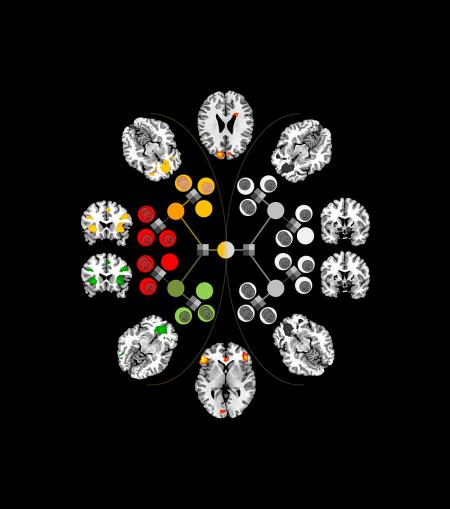
  • Caltech researchers used a combination of computational modeling and behavioral and fMRI data to pick apart the roles of various brain regions involved in a type of behavioral control. The circles (some bearing coins) and shaded squares relate to a decision-making task given to subjects in the study.
    Credit: Caltech/Sang Wan Lee/Neuron/Elsevier
- See more at: http://www.caltech.edu/content/pinpointing-brain-s-arbitrator#sthash.B38RAZaL.dpuf


02/05/2014

Pinpointing the Brain’s Arbitrator

Caltech researchers ID a brain mechanism that weighs decisions
We tend to be creatures of habit. In fact, the human brain has a learning system that is devoted to guiding us through routine, or habitual, behaviors. At the same time, the brain has a separate goal-directed system for the actions we undertake only after careful consideration of the consequences. We switch between the two systems as needed. But how does the brain know which system to give control to at any given moment? Enter The Arbitrator.
Researchers at the California Institute of Technology (Caltech) have, for the first time, pinpointed areas of the brain—the inferior lateral prefrontal cortex and frontopolar cortex—that seem to serve as this "arbitrator" between the two decision-making systems, weighing the reliability of the predictions each makes and then allocating control accordingly. The results appear in the current issue of the journal Neuron.
According to John O'Doherty, the study's principal investigator and director of the Caltech Brain Imaging Center, understanding where the arbitrator is located and how it works could eventually lead to better treatments for brain disorders, such as drug addiction, and psychiatric disorders, such as obsessive-compulsive disorder. These disorders, which involve repetitive behaviors, may be driven in part by malfunctions in the degree to which behavior is controlled by the habitual system versus the goal-directed system.
"Now that we have worked out where the arbitrator is located, if we can find a way of altering activity in this area, we might be able to push an individual back toward goal-directed control and away from habitual control," says O'Doherty, who is also a professor of psychology at Caltech. "We're a long way from developing an actual treatment based on this for disorders that involve over-egging of the habit system, but this finding has opened up a highly promising avenue for further research."
In the study, participants played a decision-making game on a computer while connected to a functional magnetic resonance imaging (fMRI) scanner that monitored their brain activity. Participants were instructed to try to make optimal choices in order to gather coins of a certain color, which were redeemable for money.
During a pre-training period, the subjects familiarized themselves with the game—moving through a series of on-screen rooms, each of which held different numbers of red, yellow, or blue coins. During the actual game, the participants were told which coins would be redeemable each round and given a choice to navigate right or left at two stages, knowing that they would collect only the coins in their final room. Sometimes all of the coins were redeemable, making the task more habitual than goal-directed. By altering the probability of getting from one room to another, the researchers were able to further test the extent of participants' habitual and goal-directed behavior while monitoring corresponding changes in their brain activity.
With the results from those tests in hand, the researchers were able to compare the fMRI data and choices made by the subjects against several computational models they constructed to account for behavior. The model that most accurately matched the experimental data involved the two brain systems making separate predictions about which action to take in a given situation. Receiving signals from those systems, the arbitrator kept track of the reliability of the predictions by measuring the difference between the predicted and actual outcomes for each system. It then used those reliability estimates to determine how much control each system should exert over the individual's behavior. In this model, the arbitrator ensures that the system making the most reliable predictions at any moment exerts the greatest degree of control over behavior.
"What we're showing is the existence of higher-level control in the human brain," says Sang Wan Lee, lead author of the new study and a postdoctoral scholar in neuroscience at Caltech. "The arbitrator is basically making decisions about decisions."
In line with previous findings from the O'Doherty lab and elsewhere, the researchers saw in the brain scans that an area known as the posterior putamen was active at times when the model predicted that the habitual system should be calculating prediction values. Going a step further, they examined the connectivity between the posterior putamen and the arbitrator. What they found might explain how the arbitrator sets the weight for the two learning systems: the connection between the arbitrator area and the posterior putamen changed according to whether the goal-directed or habitual system was deemed to be more reliable. However, no such connection effects were found between the arbitrator and brain regions involved in goal-directed learning.  This suggests that the arbitrator may work mainly by modulating the activity of the habitual system.
"One intriguing possibility arising from these findings, which we will need to test in future work, is that being in a habitual mode of behavior may be the default state," says O'Doherty. "So when the arbitrator determines you need to be more goal-directed in your behavior, it accomplishes this by inhibiting the activity of the habitual system, almost like pressing the breaks on your car when you are in drive."
The paper in Neuron is titled "Neural computations underlying arbitration between model-based and model-free learning." In addition to O'Doherty and Lee, Shinsuke Shimojo, the Gertrude Baltimore Professor of Experimental Psychology at Caltech, is also a coauthor. The work was completed with funding from the National Institutes of Health, the Gordon and Betty Moore Foundation, the Japan Science and Technology Agency, and the Caltech-Tamagawa Global COE Program. 
Written by Kimm Fesenmaier
- See more at: http://www.caltech.edu/content/pinpointing-brain-s-arbitrator#sthash.B38RAZaL.dpuf

Exhausted? It's the perfect time to make health decisions

reposted

[ Back to EurekAlert! ]
PUBLIC RELEASE DATE:
11-Feb-2014
Print | E-mail ] Share Share  Close Window ] 

Contact: Mary-Ann Twist
JCR@bus.wisc.edu
608-255-5582
University of Chicago Press Journals 

Exhausted? It's the perfect time to make health decisions

From keeping up a daily exercise routine to eating healthy foods and avoiding impulse purchases, self-control is hard work. Ironically, when it comes to making decisions about our bodies, a new study in the Journal of Consumer Research finds we make better health care decisions when we're feeling tired and run down.
"We proposed that people are more motivated to engage in healthful behavior when they are depleted and perceive their safety to be at stake," write authors Monika Lisjak (Erasmus University) and Angela Y. Lee (Kellogg School of Management, Northwestern University).
Across five experiments, the researchers looked at how consumers use what they term "self-protective motivation" when it comes to avoiding danger. They also studied consumer preference for products that emphasize safety.
In one study, participants were asked to read a health message that both described the dangers of kidney disease and advocated the benefit of early detection. The risks associated with a family history of kidney disease were also highlighted in the message. The authors found that for people with a family history of kidney disease, those who were feeling depleted exhibited a higher likelihood of being tested than those who were feeling healthy. Participants without a family history of kidney disease expressed a similar low interest in being tested regardless of how they were feeling.
In a second study looking at product selection, participants were asked to fill out a survey on health and fitness habits either before or after working out at the gym. As a thank you gift, the participants were able to choose either sunblock or moisturizer. When participants were surveyed after working out, the likelihood of choosing sunblock was much greater than choosing the moisturizer.
"Consumers value products that emphasize safety features more when they are feeling depleted. Retailers may benefit from placing safety-related products near the checkout or running ads for security-related products at the end of the day," the authors conclude.
###
Monika Lisjak and Angela Y. Lee. "The Bright Side of Impulse: Depletion Heightens Self-Protective Behavior in the Face of Danger." Journal of Consumer Research: June 2014. For more information, contact Monika Lisjak (lisjak@rsm.nl) or visit http://ejcr.org/.


[ Back to EurekAlert! ]Print | E-mail Share Share Close Window ] 


AAAS and EurekAlert! are not responsible for the accuracy of news releases posted to EurekAlert! by contributing institutions or for the use of any information through the EurekAlert! system.


Tuesday, November 5, 2013

Gambling addicts present brain function abnormalities that affect their decision-making capacity

reposted from http://canal.ugr.es/social-economic-and-legal-sciences/item/68769


Martes, 05 de Noviembre de 2013

Gambling addicts present brain function abnormalities that affect their decision-making capacity


  • University of Granada researchers compare psychological similarities and differences and brain function in cocaine addicts and gambling addicts
  • These individuals tend to make more significantly bad decisions when experiencing negative emotions like anxiety or sadness
University of Granada researchers have analysed similarities and differences in psychological profile and brain function when comparing cocaine addicts and gambling addicts. The study reveals that gambling addicts present brain function abnormalities affecting their decision-making capacity.
In two articles, recently published in Frontiers in Neuroscience, they confirm that cocaine has cumulative prejudicial effects on the functioning of areas of the brain (anterior cingulate and part of the prefrontal cortex) necessary for correct control of impulses. This has been proven through laboratory tasks and techniques that identify abnormal brain function through electroencephalography (EEG).
However, these negative effects on correct control of impulses were not present in the gamblers, as their addiction does not involve the use of toxic substances. The research—conducted at the University of Granada—shows that individuals addicted to gambling do present other brain function abnormalities in areas of the prefrontal cortex. These are related to the severity of their affliction and affect their capacity to take decisions.
Negative emotions
Principle authors lecturer José César Perales and researcher Ana Torres—of the University of Granada Department of Experimental Psychology—explain that “these bad decisions affect the individuals' ability to recognise and evaluate loss, even when this is not financial loss”. Moreover, among the volunteers who took part in the research they also found that the tendency to take bad decisions increased significantly when they experienced negative emotions such as anxiety or sadness.
From the data gathered, they have derived “practical guidelines of direct use in the psychological treatment of both addictions”. Firstly, we must bear it in mind that abnormalities provoked by chronic cocaine consumption can in turn impede treatment and, therefore, should be taken into account when establishing a prognosis.
Secondly, the researchers have identified key issues that rehabilitation-oriented treatment for pathological gambling should include, especially in the most severe cases: to directly treat the emotional problems that trigger the need to gamble, and to undergo specific training that enables the individual to adequately evaluate losses and their consequences.
This study has been conducted by researchers from the University of Granada Mind, Brain and Behavior Research Center (CIMCyC), in cooperation with the Granada Association of Gamblers in Rehabilitation (AGRAJER) and Proyecto Hombre rehabilitation centres.
poker cards
Corresponding author: José César Perales Department of Experimental Psychology University of GranadaTelephone: +34 958 246 648 E-mail address: jcesar@ugr.es