Showing posts with label olfaction. Show all posts

Wednesday, May 25, 2022

Neuroscientists Have Discovered a Phenomenon That They Can’t Explain

 reposted from ThE Atlantic


Neuroscientists Have Discovered a Phenomenon That They Can’t Explain

“Scientists are meant to know what’s going on, but in this particular case, we are deeply confused.”
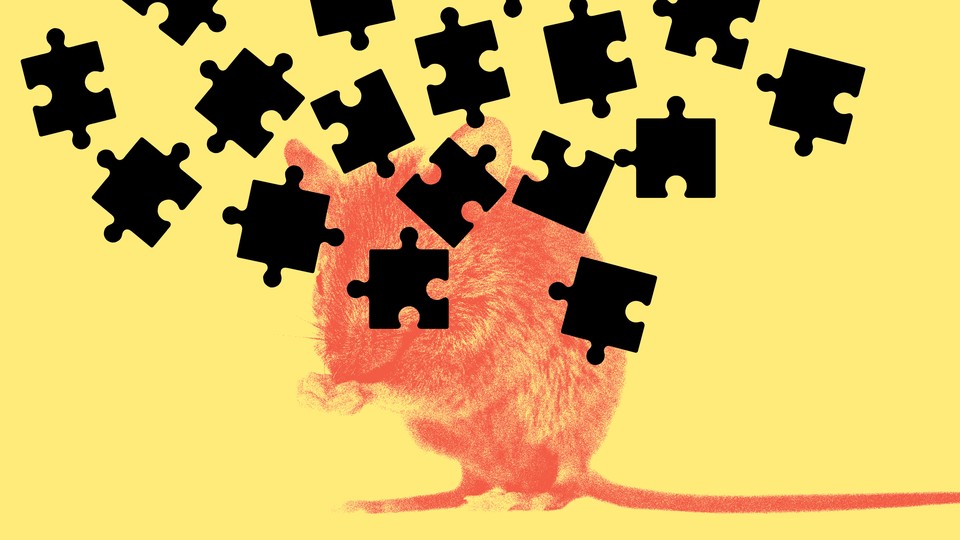
A red mouse on a yellow background with black puzzle pieces raining down
Adam Maida / The Atlantic / Shutterstock

Carl Schoonover and Andrew Fink are confused. As neuroscientists, they know that the brain must be flexible but not too flexible. It must rewire itself in the face of new experiences, but must also consistently represent the features of the external world. How? The relatively simple explanation found in neuroscience textbooks is that specific groups of neurons reliably fire when their owner smells a rose, sees a sunset, or hears a bell. These representations—these patterns of neural firing—presumably stay the same from one moment to the next. But as Schoonover, Fink, and others have found, they sometimes don’t. They change—and to a confusing and unexpected extent.

Schoonover, Fink, and their colleagues from Columbia University allowed mice to sniff the same odors over several days and weeks, and recorded the activity of neurons in the rodents’ piriform cortex—a brain region involved in identifying smells. At a given moment, each odor caused a distinctive group of neurons in this region to fire. But as time went on, the makeup of these groups slowly changed. Some neurons stopped responding to the smells; others started. After a month, each group was almost completely different. Put it this way: The neurons that represented the smell of an apple in May and those that represented the same smell in June were as different from each other as those that represent the smells of apples and grass at any one time.

This is, of course, just one study, of one brain region, in mice. But other scientists have shown that the same phenomenon, called representational drift, occurs in a variety of brain regions besides the piriform cortex. Its existence is clear; everything else is a mystery. Schoonover and Fink told me that they don’t know why it happens, what it means, how the brain copes, or how much of the brain behaves in this way. How can animals possibly make any lasting sense of the world if their neural responses to that world are constantly in flux? If such flux is common, “there must be mechanisms in the brain that are undiscovered and even unimagined that allow it to keep up,” Schoonover said. “Scientists are meant to know what’s going on, but in this particular case, we are deeply confused. We expect it to take many years to iron out.”


It had already taken years for Schoonover and Fink to even confirm that representational drift exists in the piriform cortex. They needed to develop surgical techniques for implanting electrodes into a mouse’s brain and, crucially, keeping them in place for many weeks. Only then could they be sure that the drift they witnessed was really due to changes in the neurons, and not small movements of the electrodes themselves. They started working on this in 2014. By 2018, they were confident that they could get stable recordings. They then allowed implant-carrying mice to periodically inhale different odors.

The team showed that if a neuron in the piriform cortex reacts to a specific smell, the odds that it will still do so after a month are just one in 15. At any one time, the same number of neurons fires in response to each odor, but the identity of those neurons changes. Daily sniffs can slow the speed of that drift, but they don’t eliminate it. Nor, bizarrely, does learning: If the mice associated a smell with a mild electric shock, the neurons representing that scent would still completely change even though the mice continued to avoid it. “The prevailing notion in the field has been that neuronal responses in sensory areas are stable over time,” says Yaniv Ziv, a neurobiologist at the Weizmann Institute of Science who was not involved in the new study. “This shows that’s not the case.”

“There have been hints of this for at least 15 years,” across many parts of the brain, Schoonover told me. The hippocampus, for example, helps animals navigate their surroundings. It contains place cells—neurons that selectively fire when their owner enters specific locations. Walk from your bed to your front door, and different place cells will fire. But these preferences aren’t fixed: Ziv and others have now shown that the locations to which these cells are tuned can also drift over time.

In another experiment, Laura Driscoll, a neuroscientist who is now at Stanford, placed mice in a virtual T-shaped maze, and trained them to go either left or right. This simple task depends on the posterior parietal cortex, a brain region involved in spatial reasoning. Driscoll and her colleagues found that activity in this area also drifted: The neurons that fired when the mice ran the maze gradually changed, even though the rodents’ choices remained the same.

These results were surprising, but not overly so. The hippocampus is also involved in learning and short-term memory. You’d expect it to overwrite itself, and thus to continuously drift. “Up until now, observations of representational drift were confined to brain regions where we could tolerate it,” Schoonover said. The piriform cortex is different. It’s a sensory hub—a region that allows the brain to make sense of the stimuli around it. It ought to be stable: How else would smells ever be familiar? If representational drift can happen in the piriform cortex, it may be common throughout the brain.

It might be less common in other sensory hubs, such as the visual cortex, which processes information from the eyes. The neurons that respond to the smell of grass might change from month to month, but the ones that respond to the sight of grass seem to mostly stay the same. That might be because the visual cortex is highly organized. Adjacent groups of neurons tend to represent adjacent parts of the visual space in front of us, and this orderly mapping could constrain neural responses from drifting too far. But that might be true only for simple visual stimuli, such as lines or bars. Even in the visual cortex, Ziv found evidence of representational drift when mice watched the same movies over many days.

“We have a hunch that this should be the rule rather than the exception,” Schoonover said. “The onus now becomes finding the places where it doesn’t happen.” And in places where it does happen, “it’s the three F’s,” Fink added. “How fast does it go? How far does it get? And … how bad is it?”


How does the brain know what the nose is smelling or what the eyes are seeing, if the neural responses to smells and sights are continuously changing? One possibility is that it somehow corrects for drift. For example, parts of the brain that are connected to the piriform cortex might be able to gradually update their understanding of what the piriform’s neural activity means. The whole system changes, but it does so together.

Another possibility is that some high-level feature of the firing neurons stays the same, even as the specific active neurons change. As a simple analogy, “individuals in a population can change their mind while maintaining an overall consensus,” Timothy O’Leary, a neuroscientist at the University of Cambridge, told me. “The number of ways of representing the same signal in a large population is also large, so there’s room for the neural code to move.” Although some researchers have found signs of these stable, high-level patterns in other drifty parts of the brain, when Schoonover and Fink tried to do so in the piriform cortex, they couldn’t. Neither they nor their colleagues can conclusively say how the brain copes with representational drift. They’re also unsure why it happens at all.

Drift might simply be a nervous-system bug—a problem to be addressed. “The connections in many parts of the brain are being formed and broken down continually, and each neuron is itself continually recycling cellular material,” O’Leary said. Perhaps a system like this—a gray, goopy version of the ship of Theseus—is destined to drift over time. But that idea “is a little weak,” O’Leary told me. The nervous system can maintain precise and targeted connections, such as those between muscles and the nerves that control them. Drift doesn’t seem inevitable.

Alternatively, drift might be beneficial. By constantly changing how existing information is stored, the nervous system might be better able to incorporate new material. “Information that’s not continuously useful is forgotten, while information that continues to be useful is updated with the drift,” says Driscoll, who is now testing this idea using artificial networks. “The more I’ve thought about drift, the more it makes sense that it’s something we would see in the brain.” Schoonover likes this idea too: “Our favored interpretation is that drift is a manifestation of learning,” he told me. “It’s not learning itself; it’s the smoke that comes out of learning.”

Schoonover and Fink compare the discovery of representational drift with the work of the astronomer Vera Rubin. In the 1970s, Rubin and her colleague Kent Ford noticed that some galaxies were spinning in unexpected ways that seemed to violate Newton’s laws of motion. Her analysis of that data provided the first direct evidence for dark matter, which makes up most of the matter in the universe, but has never been observed. Similarly, drift indicates “that there’s something else going on under the hood, and we don’t know what that is yet,” Schoonover said.

But the comparison between drift and Rubin’s spinning galaxies fails in one important way. Rubin knew that she was onto something odd because she could compare her data against Newtonian mechanics—a solid and thoroughly described theory of physics. No such theory exists in neuroscience. The field has a very clear idea of how individual neurons work, but it gets much fuzzier when it comes to neuronal networks, entire brains, or the behavior of whole animals.

Consider the very idea that specific patterns of firing neurons can represent different smells, sights, or sounds. That connection seems simple enough—from the perspective of the experimenter, who exposed an animal to a stimulus and then looked for active neurons in its brain. But the brain itself has to work with just half of that equation, a bunch of active neurons, to make sense of what might have triggered that activity. “Just because we can decode that information doesn’t mean the brain is doing that,” says John Krakauer, a neuroscientist at Johns Hopkins University.

For that reason, Krakauer says that Schoonover and Fink’s study, though “a technical tour de force,” is also “very slightly straw-mannish.” The idea of drift, he says, is surprising and exciting only when contrasted with the unsophisticated textbook idea of representations, which was never theoretically sound and was already being questioned. And that’s a broader problem for the entire field, he told me. “Mainstream neuroscience relies on taking very specific methods and results and packaging them in a vague cloud of concepts that are only barely agreed upon by the field,” he said. “In a lot of neuroscience, the premises remain unexamined, but everything else is impeccable.”

Fink agrees that the idea of stable representations was never a theory—more “a tacit assumption,” he said, and one that held “because it’s simple.” How could it not be that way? Well, it isn’t. So now what?

“There’s a real hunger in the field for new ideas,” Fink told me, which is why, he thinks, he and Schoonover haven’t yet faced the kind of vicious pushback that scientists with dogma-busting data tend to encounter. “People are really desperate for theories. The field is so immature conceptually that we’re still at the point of collecting factlets, and we’re not really in a position to rule anything out.” Neuroscience’s own representations of the brain still have plenty of room to drift.

Ed Yong is a staff writer at The Atlantic. He won the Pulitzer Prize for Explanatory Reporting for his coverage of the COVID-19 pandemic.

Monday, January 24, 2022

Scents and sensibility: what’s behind the rise of extreme smells?

 reposted from the guardian

https://www.theguardian.com/fashion/2022/jan/22/scents-and-sensibility-whats-behind-the-rise-of-extreme-smells?CMP=Share_iOSApp_Other

Scents and sensibility: what’s behind the rise of extreme smells?

Fresh tomato, on white background with smoke coming out of stem
 Photograph: mbbirdy/Getty Images

From tomato-scented candles to perfumes reeking of intimate body parts, the world of smell is getting weirder. But are we ready to take our olfactory desires to the next level?

One night last week, I sat in my kitchen with my eyes closed, inhaling the rich, earthy scent of tomatoes. I felt transported: I was in an Italian garden, sun-dappled leaves swaying as I picked the plump, ripe fruit for a late pasta dinner with my large and beautiful family. I was, in essence, one of the puppets from the Dolmio adverts. But the smell wasn’t coming from a tomato. It was coming from a candle.

How did they make it smell so real? I called my boyfriend over to share in this miracle. He put his face right over the flame, said that it smelled like burnt nose hair and quickly lost interest. But I remained tickled by this magic trick. A candle, that smells like tomatoes!

There is something in the air at the moment, and it’s not just vine tomato candles: ever more eclectic smells – from the uplifting to the downright bizarre – have been making their way into perfume and candles. Is it a consequence of having been so smell-starved, so downright bored during the pandemic? An increased desire for the things we buy to give us experiences beyond mere enjoyment? And why do people want to smell weird stuff?

Our interest in these smells has now spread outside our homes and into our cultural, public spaces. The past year alone has seen: an exhibition of floating machines perfumed with smells of coal, marine life and vegetation at Tate Modern; a gallery in the Hague infused with the fishy odour of a 17th-century Dutch canal; and a dedicated olfactory art space launched in New York.

Olfactory art is far from new. Coffee beans were roasted behind a screen to create “the smell of Brazil” at the International Surrealist Exhibition of 1938. And let’s not forget the experiential dining experience at places like El Bulli and the Fat Duck at the start of this century. But the fact that we still view it as something of a novelty suggests we still view smell as a lesser sense.

Novelty scents have been around for a while. In the US, Demeter Fragrance Library was established in 1996 selling perfumes based on everyday scents. It started with Dirt, Grass and Tomato, and has since expanded into more unusual smells like Play-Doh, New Car and Funeral Home. Yankee Candles’ off-the-wall options have included Bacon, Schnitzel with Noodles, and something rather unnervingly called Man Town.

Sign up to our Inside Saturday newsletter for an exclusive behind the scenes look at the making of the magazine’s biggest features, as well as a curated list of our weekly highlights.

Anya Hindmarch sells candles that smell like pencil shavings and chewing gum. D. S. and Durga make several weird scents, including one called Burning Barbershop, which is supposed to smell like a specific barbershop in New York state that caught fire. I’ve never been, but the pleasing woody smell made me want to.

Recent years have seen a rise in avant garde scents and more prosaic smells, says fragrance writer, Lizzie Ostrom. Perfumed goods used to be about beauty and vanity, she says. “But now we’re thinking, ooh, what is it that a fragrance can do? And what sorts of fragrances might I like that aren’t just the usual scents that I thought I wanted to wear?”

Surprisingly, it seems the pandemic only increased our olfactory desire. We didn’t have any nights out to smell nice for, yet somehow the fragrance industry didn’t suffer at all – perfume sales were up 45% in the first quarter of this year. “I think people discovered that fragrance was not just for someone else to smell and admire, but is primarily a personal experience, with the power to make you feel good about yourself,” said public relations specialist Daniel Williams.

Pencil shavings
Anya Hindmarch sells candles that smell like pencil shavings. Photograph: Rizky Panuntun/Getty Images

Scented candles saw a huge boost in sales, too. Deprived of many kinds of stimulation – including smells other than that of our own homes or our breath inside a face mask, it’s no wonder we turned to scented candles. If we were going to be stuck in our homes 23 hours a day, we might as well make home a nice place to be. One of the many unhinged habits I developed during the winter lockdown was sitting in my bed holding a scented candle in both hands, breathing deeply from the flame and thinking, “what am I doing?” Looking back, I think my nose was hungry.

Loss of smell as a side-effect of Covid has been a common experience in the past 18 months, and people who regain their sense of smell often report that it comes back in patchy, faulty ways – smelling things that aren’t there, or favourite foods now smelling like sewage. Doctors have recommended “smell training” : buying essential oils and sniffing them repeatedly as a sort of nose physio to try to retrain the body to sense aromas. Remedies for smell loss trending on social media include eating burnt oranges. “Getting their sense of smell back has for millions of people a real source of relief and joy – and perhaps now they’re wanting to really explore,” Ostrom said.

Vegetables are having a moment – as well as the Urban Apothecary vine tomato candle that so impressed me, I could have a Loewe room spray that smelled like coriander or beetroot – but there are also candles that smell of chlorine, and perfumes with a base note of asphalt. And all the talk of everyday smells magically replicated at the light of a wick or the pump of an atomizer has a touch of 1999 about it, of scratch-and-sniff cards, and dorky experiments with Smell-o-vision.

Last year, a lingerie brand released a range of “pillow mists”, supposedly designed to help you sleep, that smelled like celebrities such as Harry Styles and Maya Jama. Hotels, cars, sports stadiums have “signature scents”. McDonald’s did a line of Quarter Pounder-scented candles in February 2020.

Products are also increasingly taking inspiration, although one hopes not ingredients, from the human body. There’s the infamous Goop vagina candle, of course, but that’s nothing compared with a scent called Vulva Original. The Amazon listing promises “intense scent of a vagina”, and it has some of the more disturbing reviews I’ve read in my time, including: “I have met several girls and I know what that smells like …”

But for something truly out there, Etat Libre d’Orange’s Sécrétions Magnifiques is just the thing. The scent claims to smell of blood, sweat, sperm and saliva, and reviewers describe it as “upsetting”, “completely unwearable”, and like “sweaty debauchery in the locker room of an indoor pool with rusty metal ladders”.

Woman eyes closed
Why should smell remain such a neglected sense? Photograph: Getty Images

How much is this all just gimmick, simply another way to sell us stuff? Prof. David Howes, director of the Centre for Sensory Studies in Montreal and co-author of Aroma: The Cultural History of Smell, is rightly sceptical of this sort of marketing strategy, which relies on dodgy science about smell appealing to a primitive part of our brains: “The idea is that marketers can get under the conscious defences of the cerebral cortex by using smell to market things, which I think is rubbish. That kind of physiological reductionism is really just another marketing ploy.”

Still, we ought to be wary of crying gimmick at any unusual smell experiences – and scents in art galleries – because we’re not trained to take smell seriously.

Because of the Proustian madeleine moment, we in the west tend to connect smells with memories and emotions. We don’t think of, say, communication, or knowledge. Philosophers Aristotle, Kant and Hegel believed that the sense of smell it should be considered below sight and hearing, and Freud had almost a horror of smell, referring to it as something that we needed to move beyond now that we were no longer going around on all fours like dogs.

Howes goes as far to say that we live in an odour-phobic society. “Witness all of our deodorising and then re-odourising rituals: the morning shower followed by adding all these artificial scents.”

Why should smell remain such a neglected sense? Why should people wear one perfume but have a wardrobe full of clothes, several Spotify playlists, and eat different meals every night but balk at filling their living rooms with different scents? Just as we can learn to like fine whisky and coffee, we can learn to appreciate stranger smells – and perhaps should. “Our noses are woefully uneducated now,” Howes told me, “and I’m very much in favour of liberating the nose. It has been kept down for too long.”

Last week, I came across a scent called Stercus. Made by perfumer Allessandro Gualtieri, Stercus is Latin for dung. “He [Gualtieri] is eccentric to say the least,” said Daniel Williams of the PR agency. “You’re sitting there at a press launch and when you ask him what the smell is based around, he tells you it’s his anus.”

When this bottle – which I’m sorry to have to tell you is brown – arrived at my flat, I interrupted my housemate watching a documentary about space and asked him to smell it with me. I gave it a couple of spritzes, and waited.

“It’s like if you used a leather bag to steal a load of vanilla candles” he said, confusion on his face. I told him what the special note was, and we both sat there sniffing the air and thinking about arseholes. “I kind of like it,” he said. If you didn’t know what the scent’s origin was, you wouldn’t necessarily suspect, although there is an unmistakable note of the farmyard about it.

Maybe all this is only the beginning. Maybe in 50 years’ time, when we’re stinking to high heaven of all manner of as-yet unimaginable futuristic smells, we’ll look back and think: “Chewing gum candles? Anus perfume? That’s nothing.”

… as you’re joining us today from Canada, we have a small favour to ask. Tens of millions have placed their trust in the Guardian’s fearless journalism since we started publishing 200 years ago, turning to us in moments of crisis, uncertainty, solidarity and hope. More than 1.5 million supporters, from 180 countries, now power us financially – keeping us open to all, and fiercely independent.

Unlike many others, the Guardian has no shareholders and no billionaire owner. Just the determination and passion to deliver high-impact global reporting, always free from commercial or political influence. Reporting like this is vital for democracy, for fairness and to demand better from the powerful.

And we provide all this for free, for everyone to read. We do this because we believe in information equality. Greater numbers of people can keep track of the global events shaping our world, understand their impact on people and communities, and become inspired to take meaningful action. Millions can benefit from open access to quality, truthful news, regardless of their ability to pay for it.

If there were ever a time to join us, it is now. Every contribution, however big or small, powers our journalism and sustains our future. Support the Guardian from as little as CA$1 – it only takes a minute. If you can, please consider supporting us with a regular amount each month. Thank you.