Showing posts with label media. Show all posts

Wednesday, July 7, 2021

Dancing with music can halt most debilitating symptoms of Parkinson's disease


https://medicalxpress.com/news/2021-07-music-halt-debilitating-symptoms-parkinson.html


Dancing with music can halt most debilitating symptoms of Parkinson's disease
Dancing with music can halt most debilitating symptoms of Parkinson's disease
Credit: York University

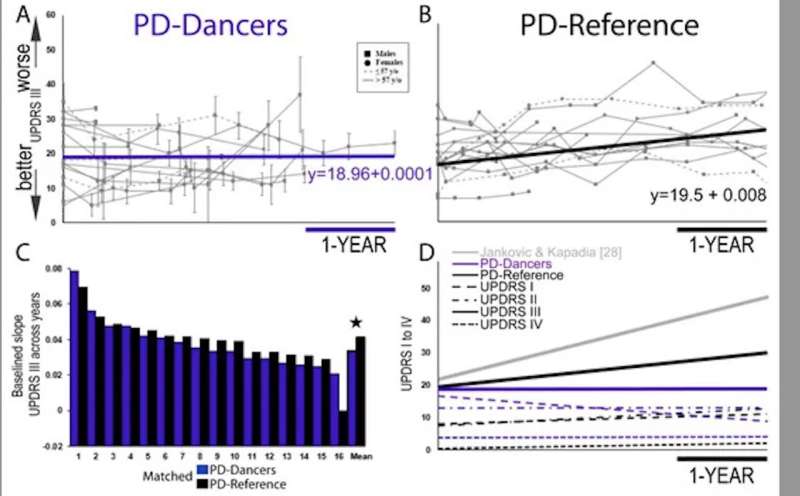
A new study published in Brain Sciences shows that patients with mild-to-moderate Parkinson's disease (PD) can slow the progress of the disease by participating in dance training with music for one-and-a-quarter hours per week. Over the course of three years, this activity was found to reduce daily motor issues such as those related to balance and speech, which often lead to social isolation.

Joseph DeSouza, senior author, principal investigator and associate professor in the Department of Psychology at York University and Ph.D. candidate Karolina Bearss, found people with Parkinson's (PwPD) who participated in weekly  training, had less motor impairment and showed significant improvement in areas related to speech, tremors, balance and rigidity compared to those who did not do any dance exercise. Their data showed significant improvements in experiences of daily living, which include cognitive impairment, hallucinations, depression and anxious mood such as sadness. The study showed overall that non-motor aspects of daily living, motor experiences of daily living, motor examination symptoms and motor complications did not show any impairment across time among the dance-trained PwPD group compared to PwPD who do not dance.

The study is the first of its kind to follow PwPD over a three-year period during weekly dance participation with music, providing additional information regarding the nature of progression of motor and non-motor PD symptoms.

"The experience of performing and being in a studio environment with dance instructors appears to provide benefits for these individuals," said DeSouza. "Generally, what we know is that dance activates brain areas in those without PD. For those with Parkinson's disease even when it's mild motor impairment can impact their daily functioning—how they feel about themselves. Many of these motor symptoms lead to isolation because once they get extreme, these people don't want to go out. These motor symptoms lead to further psychological issues, depression, social isolation and eventually the symptoms do get worse over time. Our study shows that training with dance and music can slow this down and improve their daily living and daily function."

The goal of the research was to create a long-term neurorehabilitation strategy to combat the symptoms of PD. In the study, researchers looked at how a multi-sensory activity, (like dance with music learning) which incorporated the use and stimulation of several sensory modalities in the dance environment including vision, audition, tactile perception, proprioception, kinesthesia, social organization and expression, olfactory, vestibular and balance control—may influence many of the mood, cognitive,  and neural challenges faced by PwPD.

Researchers followed collected data from PwPD over three-and-a-half years while they learned choreography over the first year and performed it, that is designed to be adaptable to the disease stage and current symptoms for PwPD.

In the study, 16 participants with mild-to-moderate PD (11 males, five females) with an average age of 69, were tested between October 2014 and November 2017. They were matched for age and severity of disease. Each participant took part in a 1.25-hour dance class at Canada's National Ballet School (NBS) and Trinity St. Paul's church locations. Dancers participated in dance exercises which provided both aerobic and anaerobic movements. This group was then compared to 16 non-dance PwPD participants (the reference group) chosen from a larger PwPD cohort from the Parkinson's Progression Marker Initiative (PPMI), a longitudinal research project funded by the Michael J. Fox Foundation for Parkinson's Research (MJFF) and related funding partners.

Classes began with live music accompaniment during the seated warm-up, followed by barre work, and ended with moving across the floor. All participants learned choreography for an upcoming performance. Researchers recorded videos, conducted paper and pen questionnaires of all participants and performed statistical analyses.

"Dance is so complex, it's a multi-sensory type of environment," said Bearss. "It incorporates and stimulates your auditory, tactile, visual and kinesthetic senses and adds an interactive social aspect. Regular exercise does not offer these aspects. There's so much more to dance."

Researchers will next examine what occurs in the brain immediately before and after a dance class to determine what neurological changes take place.

"Currently there is no precise intervention with PD and usual remedies are pharmacological interventions, but not many options are given for alternate exercises or additional interventions to push their brains," said DeSouza. "Hopefully this data will shed light on additional therapies for this group and be used in the treatment process. There may be changes in the brain that occur with dance with music, but more research is necessary."


Explore further

Practice makes perfect, brain study confirms

More information: Karolina A. Bearss et al, Parkinson's Disease Motor Symptom Progression Slowed with Multisensory Dance Learning over 3-Years: A Preliminary Longitudinal Investigation, Brain Sciences (2021). DOI: 10.3390/brainsci11070895
Provided by York University 

Dancing can improve symptoms of Parkinson's disease in some patients, study shows

 reposted from


https://www.ctvnews.ca/health/dancing-can-improve-symptoms-of-parkinson-s-disease-in-some-patients-study-shows-1.5500250


Dancing can improve symptoms of Parkinson's disease in some patients, study shows

Published Wednesday, July 7, 2021 3:03PM EDTLast Updated Wednesday, July 7, 2021 3:03PM EDT
Volume 90%
 
Ontario mom Caitlin Nagy was diagnosed with the disease at 31, and shares her story.

TORONTO -- People living with mild to moderate Parkinson’s disease can improve their motor function and quality of life with weekly dance classes, a new study has found.

Parkinson’s disease is a neurological illness that affects the nervous system and occurs when nerve cells in the brain degenerate. The loss or impairment of nerve cells progressively leads to dysfunction in motor skills, such as walking, keeping one’s balance, and speech impairment.

Although it is a degenerative disease, a study released Wednesday by York University in Toronto suggests that debilitating symptoms can be improved with weekly dance classes.

“Currently there is no precise intervention with PD [Parkinson’s disease] and usual remedies are pharmacological interventions, but not many options are given for alternate exercises or additional interventions to push their brains,” Joseph DeSouza, senior author of the study and associate professor at York University, said in a press release. “The experience of performing and being in a studio environment with dance instructors appears to provide benefits for these individuals.”

The study was done over a span of three years – between October 2014 and November 2017 – and involved 11 males and five females for a total of 16 participants. The average age of people who took part in the study was 69 and all participants had mild to moderate symptoms of Parkinson’s disease.

For this study, researchers looked at how a multi-sensory activity like dance could influence the cognitive and motor challenges that those with Parkinson’s disease face. Participants would attend dance classes for an hour and 15 minutes every week at Canada’s National Ballet school, and in the weekly classes, they would start off with a seated warm-up, barre work, and finish off the class with movements across the room. Participants also learned choreography.

While analyzing the classes, researchers found that those who danced showed less impairment in motor skills compared to 16 people living with Parkinson’s disease who did not participate in the dance classes. Researchers also saw an improvement in speech and stiffness.

“Dance is so complex, it’s a multi-sensory type of environment,” PhD candidate Karoline Bearss, who helped conduct the study, said in a statement. “It incorporates and stimulates your auditory, tactile, visual, and kinesthetic senses and adds an interactive social aspect. Regular exercise does not offer these aspects. There’s so much more to dance.”

Those who took part in weekly dance classes also showed an improvement in quality of life, which DeSouza says is often affected when Parkinson’s begins to hinder their motor skills and cognitive abilities.

“For those with Parkinson’s disease, even when it’s mild, motor impairment can impact their daily functioning – how they feel about themselves. Many of these motor symptoms lead to isolation because once they get extreme, these people don’t want to go out,” he said.

“These motor symptoms lead to further psychological issues, depression, social isolation and eventually the symptoms do get worse over time. Our study shows that training with dance and music can slow this down and improve their daily living and daily function.”

With this research, DeSouza said that he hopes there will be more treatment alternatives for those living with Parkinson’s disease, and though there may be changes in the brain with dance, more research is needed.

Friday, May 15, 2020

Our new article from the group from Charles: Non-motor Clinical and Biomarker Predictors Enable High Cross-Validated Accuracy Detection of Early PD but Lesser Cross-Validated Accuracy Detection of Scans Without Evidence of Dopaminergic Deficit

Take a look at our new lab article

https://www.frontiersin.org/articles/10.3389/fneur.2020.00364/full

and related news articles thus far.
https://yfile.news.yorku.ca/2020/05/13/predictive-models-could-help-provide-more-accurate-detection-of-early-stage-parkinsons-disease/?utm_source=YFile_Email&utm_medium=Email&utm_content=Top-Stories&utm_campaign=yfile


https://www.eurekalert.org/pub_releases/2020-05/yu-pmc051120.php


https://www.technologynetworks.com/tn/news/loss-of-smell-and-sleep-disorders-prove-effective-at-predicting-parkinsons-onset-334663


https://infosurhoy.com/news-summary/predictive-models-could-provide-more-accurate-detection-of-early-stage-parkinsons-disease/

https://medicalxpress.com/news/2020-05-accurate-early-stage-parkinson-disease.html

 like this one with the slides from cajal......
https://myneuronews.com/blog/2020/05/11/non-motor-clinical-and-biomarker-predictors-enable-high-cross-validated-accuracy-detection-of-early-pd-but-lesser-cross-validated-accuracy-detection-of-scans-without-evidence-of-dopaminergic-deficit/

https://www.news-medical.net/news/20200511/Predictive-models-could-more-accurately-detect-early-stage-Parkinsons-disease.aspx


https://frontiers.altmetric.com/details/81799208/news

<script type="text/javascript" src="https://d1bxh8uas1mnw7.cloudfront.net/assets/embed.js"></script><div class="altmetric-embed" data-badge-type="donut" data-altmetric-id="81799208"></div>

Saturday, March 11, 2017

Dancing with Parkinson's research Something about dancing seems to rewire the brain and create new pathways that control movement

our lab work profiled with Sarah's class
http://www.cbc.ca/news/health/parkinson-dance-1.3832945

Dancing with Parkinson's research

Something about dancing seems to rewire the brain and create new pathways that control movement

By Ioanna Roumeliotis, CBC News Posted: Jan 23, 2017 9:00 PM ET Last Updated: Jan 23, 2017 9:00 PM ET
Alice-Betty Rustin and Charles Dennis participate in a Dancing with Parkinson's research project. He says it would be great to be part of the victory over the disease.
Alice-Betty Rustin and Charles Dennis participate in a Dancing with Parkinson's research project. He says it would be great to be part of the victory over the disease. (David Donnelly/CBC)
His body doesn't move quite so naturally anymore. His limbs often feel stiff. Every movement is an exercise of will. But when he's dancing to the strains of a soft waltz, 60-year-old Charles Dennis gets lost in the rhythm and for a brief moment forgets how desperately he wants to keep moving.
Media placeholder
Dance lesson0:21
"I find myself really getting caught up in the music and you forget about, you forget about having to make the movement, to be sure your arm is getting the message from your brain to move this way," says Dennis who was diagnosed with Parkinson's disease last year.
Choking back a sob, he adds, "They don't know what causes it. It'd be great to be part of the victory over it."
Media placeholder
Fighting this0:32
Parkinson's is a neurological disorder that progressively robs a person's ability to move. It also affects co-ordination, balance, strength and can interfere with the ability to speak clearly. 
For nearly a decade Sarah Robichaud, a classically trained dancer, founder and instructor with Dancing with Parkinson's, has been seeing what scientists are now trying to prove.
"Anecdotally, what the students tell us and what we see, maybe, you know, new neuro-pathways are being created," says Robichaud, "because people sometimes who walk in with walkers, who are very unstable, halfway through the class will start waltzing through the room unassisted."

Renewed brain activity

The scientific explanation for why that is happening is now emerging. Joseph De Souza is a neuroscientist from Toronto's York University. For the last three years, he and his researchers have been tracking the brainwaves of dozens of people in Robichaud's dance classes.
Volunteers undergo a brain scan before and after a one-hour dance class. They also perform a series of physical tests to measure the impact the classes have on their gait and coordination.
"Almost everyone that participates in the classes notice improvement in movements, claim improvement in quality of life and in mood, like emotion," says DeSouza. "What we're interested in is seeing how in the brain or where in the brain it's changing over time."
There is evidence already that exercise, especially strenuous activity, builds muscle and brain power in people with Parkinson's. The data on dancing is preliminary but also promising.
DeSouza recently presented his early findings at an international conference on Parkinson's.
Sarah Robinson
People sometimes walk in with walkers and halfway through the class will start waltzing through the room unassisted, says Sarah Robichaud. (David Donnelly/CBC)
He's found a one hour dance class results in a boost in alpha brain waves. That renewed brain activity may explain why most volunteers show an improvement in their balance and gait after a class.
DeSouza says he wants to determine what that does to the progression of the disease.
"We want to see whether it's a neuroprotective thing that's happening as a function of dance. So, we're not only interested in what's happening in the brain, but how it's happening and whether it's neuroprotective over time."
DeSouza's research is still in its infancy and his sample size is small. About 50 people with Parkinson's are in the study. But what he's learned is already informing experts in the field.
Dr. Galit Kleiner runs the Movement Disorder Clinic at Toronto's Baycrest Hospital. She's on top of all the medical interventions that help her patients, mostly medications that help with tremors.
"There's sort of an internal rhythm in all of us, but especially in Parkinson's patients that rhythm is impaired. The motor circuits of actually moving are intact, but the accessing of those circuits may not be intact. And, so, music and even pacing with a metronome, may be able to access those motor pathways."

Recommends to patients

Kleiner says there aren't huge clinical trials to draw on, to prove how well non-medical therapies work. And she's not waiting for them. She says the emerging research on therapies like dancing is good enough and she recommends it to her patients because it seems to help and already proves it gives people hope.
Media placeholder
Social connection0:38
It's harder to measure optimism but DeSouza is convinced the emotional boost a group offers plays a role. And he and his team want to keep following the volunteers for at least five more years, to see if the positive effects last. Ultimately the goal is to identify markers, or patterns that will predict Parkinson and allow for early interventions,  like dancing.
As for Dennis, the disease is still an unfamiliar companion and he still struggles with what the future may hold. And though his hope wavers at times, dancing he says is an exercise of faith and a belief the science will follow.
Media placeholder
Die with Parkinson's0:22